Air taxi private jet: destinations, prices, aircraft…
The private jet air taxi is the fastest and most flexible way to reach a city poorly served by scheduled airlines: an on-demand flight, departing within 3 to 4 hours of your call, on a 3- to 8-seat aircraft capable of landing on short runways that neither an Airbus nor most private jets can use. Originally introduced in the 1960s to bridge the gap between scheduled commercial aviation and VIP charter flights, the air taxi has established itself in 2026 as the premium yet reasonable option for same-day business round trips.
Sitting halfway between an airliner and a conventional private jet, the air taxi draws on two aircraft families: Very Light Jets (VLJ), such as the Phenom 100, Citation Mustang, and HondaJet, and turboprops (Pilatus PC-12, TBM 900, King Air, Cessna Grand Caravan). Hourly rate: from €580 to €2,400 before tax depending on the aircraft, compared with €4,000 to €10,000 for a long-range jet. Here is the complete 2026 guide — destinations, prices, aircraft, and tips for booking.
What is an air taxi?
An air taxi — also known as a taxi plane, jet taxi, or air shuttle — is an on-demand business aviation service operated on small to mid-size aircraft, typically seating between 3 and 9 passengers. Unlike a scheduled airline, there are no fixed timetables or regular routes: you call, you provide your departure and destination airports along with your passenger list, and an aircraft takes off for you, sometimes within 3 to 4 hours of your request.
Three features set air taxis apart from other forms of private aviation:
- Ability to land on small runways — where a typical private jet requires 1,500 metres of paved runway, an air taxi needs only 750 metres, sometimes less for certain turboprops. As a result, it can access more than 1,600 European airports (up to 4,000 airfields including grass strips), compared with just 300 served by commercial aviation.
- Affordable pricing — with hourly flight rates between €580 and €2,500, up to 50% less expensive than a conventional private jet for 1 to 3 passengers travelling under 1,000 km.
- Operational responsiveness — no check-in, no security queue. Simply arrive 10 to 15 minutes before take-off, and your pilot greets you at the foot of the aircraft.
The service first appeared in the United States in the 1960s and then expanded across Europe to meet a specific need: connecting two secondary cities without going through a major hub, ideally as a same-day return trip. Europe’s dense regional airfield network — on average, an airfield every 15 minutes — explains why the model is particularly well suited to the continent.
Air taxi vs conventional private jet: the real differences
The two services are often conflated, but they answer two distinct needs, as the table below illustrates:
| Criterion | Air taxi | Conventional private jet |
|---|---|---|
| Hourly rate (excl. tax) | €580 to €2,400 | €2,500 to €10,000+ |
| Optimal capacity | 1 to 6 passengers | 4 to 19 passengers |
| Range | Regional, up to 1,000 km | 1,500 km to 13,000 km+ |
| Minimum runway | 750 m (grass/sand possible) | 1,500 m paved |
| European airports accessible | 1,600 to 4,000 | ~800 |
| Booking lead time | Often under 24 h | Subject to availability |
| Boarding | 10–15 min before departure | 20–30 min before departure |
| Best for | Trips under 1,000 km, small groups | Long-haul flights, large parties, comfort |
In simple terms, an air taxi is “a sprinter” while a long-range private jet is “a distance runner”. Over 500 km (Antwerp–Zurich, for instance), the jet only saves about twenty minutes in flight… at twice the cost. Beyond 1,000 km, however, or to carry more than four passengers in comfort, the trade-off shifts back in favour of the private jet.
Which aircraft are used as air taxis?
The air taxi fleet falls into two main categories: turboprops, robust and economical, and Very Light Jets (VLJ), faster and flying higher. Here are the models most commonly used in Europe in 2026, with their key characteristics:
| Model | Type | Seats | Range | Indicative hourly rate (excl. tax) | Typical use |
|---|---|---|---|---|---|
| Cirrus SR22 | Piston | 3 | 1,600 km | ~€580 | Short regional flights, 1–3 pax |
| Cessna Grand Caravan EX | Turboprop | 9 | 1,800 km | ~€1,000 | Very short runways, groups of 6–9 |
| TBM 900 / 910 | Turboprop | 5 | 2,778 km | ~€1,200 | Fast flights, Alpine altiports |
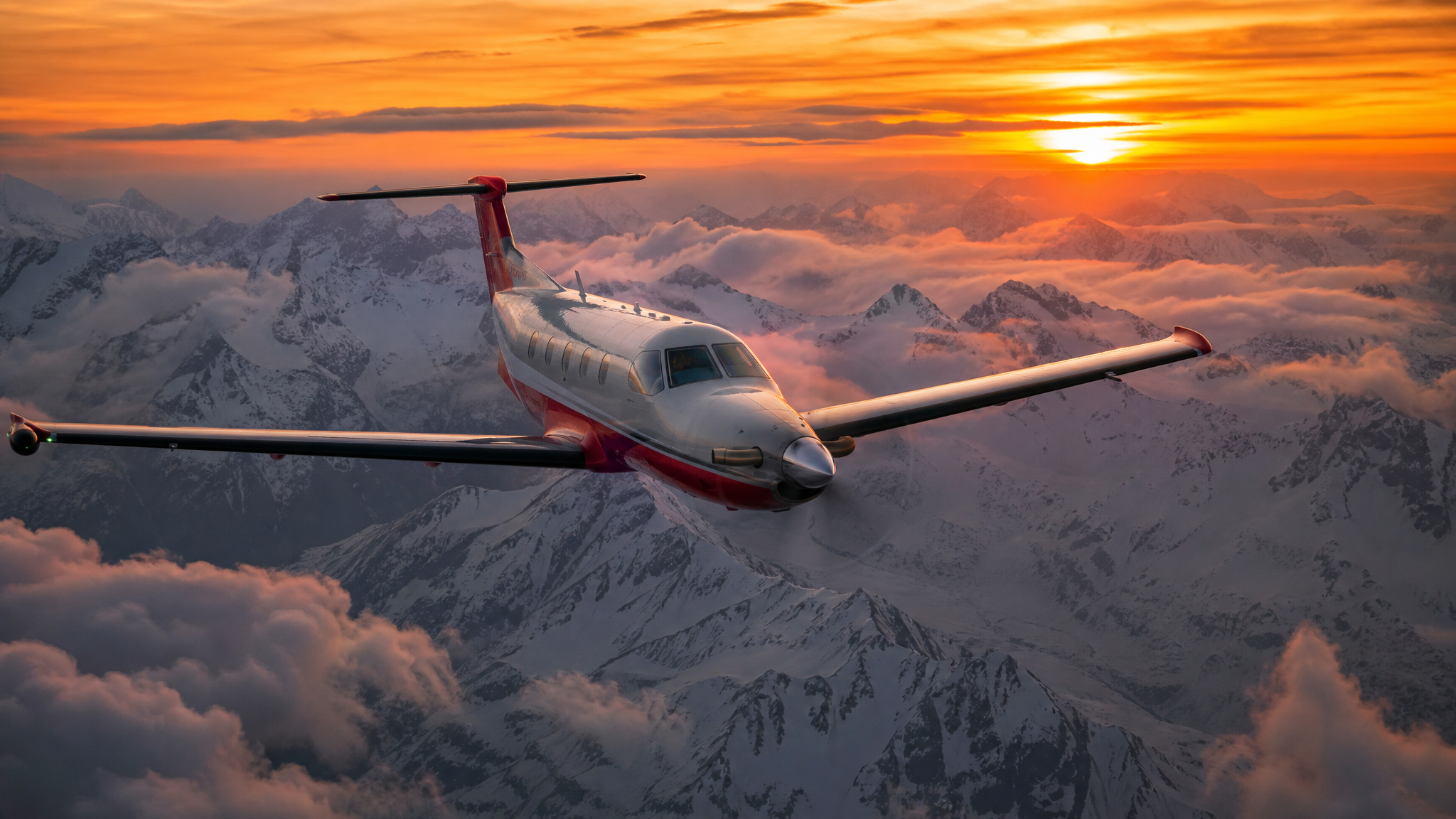
| Pilatus PC-12 NGX | Turboprop | 6–9 | 2,800 km | ~€1,400 | Versatile, grass strips |
| Beechcraft King Air 350 | Turboprop | 8–9 | 2,770 km | ~€1,600 | Regional business groups |
| Embraer Phenom 100 | Very Light Jet | 4 | 1,704 km | ~€1,900 | Express 1–2 h trips, BMW-designed interior |
| Cessna Citation Mustang | Very Light Jet | 4 | 2,161 km | ~€1,900 | Pressurised cabin, short haul |
| HondaJet Elite | Very Light Jet | 5 | 2,661 km | ~€2,100 | The most fuel-efficient on the market |
| Cirrus Vision SF50 | Single-engine jet | 6 | 2,200 km | ~€2,200 | Personal jet, CAPS whole-aircraft parachute |
| Pilatus PC-24 | Light Jet | 6–8 | 3,700 km | ~€2,800 | “Super Versatile Jet”, short runways |
| Embraer Phenom 300E | Light Jet | 6–8 | 3,724 km | ~€3,200 | The world’s best-selling light jet |
The choice between turboprops and VLJs depends on three factors: distance (a turboprop remains competitive up to 800 km, the VLJ takes the lead beyond that), destination (a PC-12 or King Air can land where no jet can), and budget (the piston-engined Cirrus SR22 starts at €580/hour, three to four times less than a VLJ).
Air taxi prices in 2026
An air taxi flight is priced on the same model as a conventional private jet: billed by the flight hour, plus airport fees, navigation charges, fuel, and VAT (10% in mainland France for domestic flights, exempt internationally). Here are the price brackets by aircraft category:
| Aircraft category | Capacity | Hourly rate (from) | Example models |
|---|---|---|---|
| Piston aircraft | 3 pax | €580 | Cirrus SR22, Diamond DA-42 |
| Light turboprop | 4–6 pax | €1,000 | TBM 900, Cessna Grand Caravan |
| Heavy turboprop | 6–9 pax | €1,400 | Pilatus PC-12, King Air 350 |
| Very Light Jet (VLJ) | 4–5 pax | €1,700 | Phenom 100, Citation Mustang, HondaJet |
| Light Jet | 6–8 pax | €2,300 | Citation CJ3, Phenom 300, Pilatus PC-24 |
| Mid-size jet | 7–9 pax | €3,400 | Citation XLS+, Learjet 75 Liberty |
Billing is always based on a minimum of two flight hours (outbound and return combined). If your Paris–Lyon flight actually lasts 50 minutes, you will still be charged for two hours: this is the industry standard, designed to recover crew and aircraft positioning costs. Conversely, an aircraft already positioned at the right airfield — for example, a Cirrus SR22 already at Paris-Toussus — avoids the positioning flight charge and trims the bill by 20 to 40%.
Sample route prices (4 passengers, 2026)
More telling than an hourly rate: here is a price list for routes regularly flown by air taxi, on a whole-aircraft basis with 4 passengers on board.
French domestic and cross-border routes
| Route | Typical aircraft | Duration | Whole-aircraft price (excl. tax) |
|---|---|---|---|
| Paris ↔ Lyon | Citation Mustang | 0h55 | €4,000 |
| Paris ↔ Lille | Citation Mustang | 0h45 | €3,900 |
| Paris ↔ Toulouse | Phenom 100 | 1h30 | €4,800 |
| Paris ↔ Strasbourg | Pilatus PC-12 | 1h00 | €2,760 |
| Paris ↔ Saint-Étienne | King Air 350 | 1h10 | €4,400 |
| Paris ↔ Courchevel | Piper JetProp DLX | 1h20 | €3,599 |
| Paris ↔ Geneva | Diamond DA-42 | 1h32 | €1,151 |
| Paris ↔ Nice | TBM 850 | 1h52 | €4,250 |
| Brest ↔ Bilbao (same-day return) | Piper JetProp | 1h27 | €2,182 |
European routes
| Route | Duration | Whole-aircraft price (excl. tax) |
|---|---|---|
| Lyon → Genoa | 1h15 | €3,500 |
| Milan → Cannes | 1h05 | €4,200 |
| Geneva → Nice | 1h10 | €4,500 |
| Paris → Basel | 1h20 | €7,000 |
| Munich → Monaco | 1h25 | €5,000 |
| Zurich → Monaco | 1h15 | €6,000 |
| Rome → Split | 1h30 | €6,000 |
| Paris → Dubrovnik | 2h20 | €9,000 |
| Munich → Palma | 2h10 | €7,500 |
| London → Salzburg | 2h15 | €10,000 |
| Naples → Berlin | 2h20 | €10,500 |
All things considered — including business class on scheduled airlines — a Paris–Lyon air taxi flight with 4 passengers “works out to the same price as business class”, with a bonus of 2 to 3 hours saved over the day. For more exotic itineraries (Belgium–Thailand, Maldives–Courchevel, UAE–France), expect €35,000 to €100,000 with specialist long-haul operators.
Popular air taxi destinations
The primary use of the air taxi is reaching secondary cities that are poorly served by scheduled airlines. In 2026, here are the most requested departure and arrival airfields among our clients:
Alpine altiports and ski resorts
Booking an air taxi lets you land directly at Courchevel (altiport at 2,008 m altitude, 537-metre runway with an 18.5% incline) — an airfield inaccessible to most private jets. The same applies to Sion, Annecy-Meythet, Saanen (Gstaad), Megève, and Chambéry. Only pilots holding the specific “altiport” certification can operate there: a rare expertise, sometimes invoiced as an extra.
French Riviera
On the French Riviera, the busiest air taxi routes are Geneva–Nice, Paris–Saint-Tropez (landing at La Môle, 1,200 m runway), Milan–Cannes, and London–Monaco (heliport or landing at Nice with a helicopter transfer). Demand peaks during the Cannes Film Festival, the Monaco Grand Prix, and the summer season.
Mediterranean islands
Ibiza, Palma, Olbia (Sardinia), Figari (Corsica), Mykonos, Santorini, Naxos: all of these islands have airfields suited to a VLJ or a turboprop. The air taxi’s advantage: arriving in the morning without connections, returning in the evening — a precious benefit when scheduled airlines drastically cut rotations off-season.
Secondary business cities
Saint-Étienne, Tours, Limoges, Reims, Avranches, Brest, secondary Bordeaux airfields, Vatry, Le Touquet, Deauville: France alone has over 450 airfields able to accommodate an air taxi. When your meetings take place in an industrial zone 40 minutes from the regional capital, an air taxi saves you half a day compared with the high-speed train plus a hire car.
Why choose an air taxi: 7 decisive benefits
1. Time saved on a same-day return trip
A Paris–Lyon flight on a scheduled airline takes 55 minutes in the air but four hours door to door once you factor in security, waiting, and transfers. An air taxi from Paris-Le Bourget: 10 minutes from your car to the runway, 55 minutes of flight, 5 minutes to reach your car on the Lyon side — that is 1 hour 10 minutes door to door. Over an outbound and return trip, you reclaim more than 5 hours of productive time.
2. Access to small airfields
While an Airbus A320 can only land at about 1,800 airports worldwide, the Pilatus PC-12 has access to more than 20,000 — most of them grass or unpaved strips. This is the reason for being of the air taxi: reaching exactly where your client, your factory, or your event is located.
3. Flexibility until the last minute
A meeting running late? Pushing your flight back from 4 pm to 8 pm is settled with a single phone call. The pilot waits, the aircraft stays on standby for you. No scheduled airline offers this level of agility, and that is what often justifies the premium.
4. Onboard productivity
A Booz Hamilton study measured an extra 153 minutes of productive time gained per trip with business aviation compared with a commercial flight. The NBAA adds that 20% of private aviation users say they are more productive in flight, whereas business class passengers on scheduled airlines show a 36% drop in productivity.
5. Cost-effectiveness for small groups
For a Paris–Geneva flight with 4 people, an air taxi at €4,500 (excl. tax) works out to €1,125 per passenger — close to a business-class scheduled fare… with 2 hours saved. When your whole team travels together on the same mission, the calculation becomes self-evident.
6. Confidentiality
No check-in, no boarding lounge, no public passenger manifest: your trip remains invisible. For M&A activity, sensitive negotiations, or political travel, the air taxi has become a fully-fledged governance tool.
7. Onboard comfort
While the interior of an air taxi is more compact than that of a Falcon or Global, it still offers leather seats, a pressurised cabin, Wi-Fi on most aircraft, and even — on Cirrus models — noise-cancelling headsets with microphones for communication between passengers and the pilot. An “isolation” option mutes the cockpit channel for confidential conversations.
How to pay less for your air taxi
An air taxi remains an investment: €4,000 to €10,000 for a typical European trip. Here are the five levers to bring the bill down without compromising on service.
1. Empty legs
When an aircraft drops a passenger off in Nice and returns to Paris empty, the operator tries to sell that return flight at a discount. These are empty legs: discounts of up to 75% off the standard price. The catch: full flexibility on dates and times. Our low-cost private jet guide covers the seven methods to take advantage of them.
2. Jet sharing (seat sharing)
Rather than chartering the whole aircraft, you book seats on an aircraft shared between several clients on the same route. Available on the busiest corridors (Paris–Geneva, Nice–Paris, London–Saint-Tropez in summer), jet sharing brings the per-seat price down to between €500 and €1,500 — less than a regular business-class fare.
3. Prepaid cards
For regular users (more than 25 flight hours per year), operators offer prepaid cards with a flat hourly rate locked in for 12 months, with no positioning fees and no peak-time surcharges. Saving: 10 to 25%.
4. Airport flexibility
Shifting your destination airport by 30 km — choosing Toulon-Hyères rather than Nice, or Cannes-Mandelieu rather than Nice — can reduce the price by 20 to 40%, simply because landing fees are lower and slots are less in demand.
5. Early booking on positioning flights
If you know in advance that an aircraft will be positioned on the same day as your flight, you can avoid the empty positioning surcharge. This is often achievable when an operator is returning from Cannes or Nice on a Sunday evening to reach Paris-Le Bourget: your flight is grafted onto that return leg.
How to book an air taxi
The booking process for an air taxi involves five straightforward steps:
- Quote request — by phone or through the online form. Specify your departure and arrival airports, the date, the preferred time, the number of passengers, and any optional services (champagne, helicopter transfer, pets).
- Aircraft selection — within 30 minutes on average, you receive 2 to 3 aircraft options with their all-inclusive prices. The broker or operator weighs availability, positioning, runway accessibility, and your budget.
- Contract and deposit — electronic signature of the charter contract, deposit of 30 to 50%. The balance is settled before the flight.
- Passenger documents — identity card or passport depending on the destination, passenger manifest, baggage weight restrictions. For international flights, also plan for visas and customs formalities (sometimes handled through a VIP terminal such as the one at Paris-Le Bourget).
- Boarding — arrival 10 to 15 minutes before departure. No security checks as in scheduled aviation, no queues. You board, the pilot receives clearance, you take off.
For bookings under 24 hours (urgent flights, crisis travel), call a broker directly: it is faster than the online form. To understand step by step what happens between booking and landing, see our complete guide to how a private jet flight works.
FAQ: private jet air taxi
How much does an air taxi cost?
In 2026, an air taxi rents for between €580 and €2,400 per flight hour before tax, depending on the aircraft. Expect €1,100 to €6,700 for a domestic French or cross-border flight, and €4,500 to €15,000 for longer European trips. Billing is based on a minimum of two flight hours, and VAT is 10% on domestic flights in mainland France (exempt internationally).
What is the difference between an air taxi and a private jet?
The air taxi uses smaller aircraft (3 to 9 seats) and more economical models (turboprops, Very Light Jets), ideal for regional trips up to 1,000 km. A conventional private jet accommodates 4 to 19 passengers over distances of up to 13,000 km, at an hourly rate 2 to 4 times higher. The air taxi can land on runways as short as 750 metres, and even on grass: a typical private jet requires 1,500 metres of paved runway.
Which aircraft are used as air taxis?
The most common models in Europe are the Pilatus PC-12, TBM 900, King Air 350, and Cessna Grand Caravan on the turboprop side; and the Phenom 100, Citation Mustang, HondaJet Elite, Pilatus PC-24, and Phenom 300E on the light jet side.
How many airports are accessible by air taxi?
An air taxi can land at more than 1,600 airfields in Europe (up to 4,000 if you count grass and unpaved strips), compared with only 300 served by scheduled airlines. France alone has more than 450 airfields capable of accommodating an air taxi.
How far in advance should you book?
Most flights are booked 24 to 48 hours in advance. For urgent flights, operators can arrange a departure within 3 to 4 hours of the call, subject to the availability of a nearby aircraft. For peak-season routes (the Riviera in July and August, Courchevel at Christmas), allow 1 to 2 weeks’ lead time.
How much luggage can you bring?
On a light aircraft such as the Cirrus SR22, allow 10 kg maximum per passenger, with soft bags recommended. On a Pilatus PC-12, Phenom 100, or King Air, the hold accepts 50 to 100 kg per passenger (two suitcases plus a cabin bag). Skis and golf clubs are allowed — flag them at booking.
Can you fly with a pet?
Yes, and this is one of the air taxi’s major advantages: your dog or cat travels with you in the cabin, with no crate or hold required. Specify the species, breed, and weight when booking. For international flights, check the destination’s animal health entry requirements.
Is the air taxi as safe as a private jet?
Yes. European operators are all certified by EASA (European Union Aviation Safety Agency), pilots accumulate on average 2,000 to 10,000 flight hours, and aircraft are maintained to the same standards as private jets. Some models such as the Cirrus SR22 and Vision SF50 are even fitted with a ballistic parachute (CAPS system) capable of slowing the entire aircraft in an emergency.
What happens in bad weather?
Air taxis are equipped with advanced avionics (IFR, de-icing, anti-collision) allowing them to fly in most conditions, including in clouds and rain. In very strong winds or severe icing, the flight can be delayed by a few hours or re-routed to an alternative airfield. The operator makes the final decision — safety comes first.
Is the air taxi cheaper than a private jet for the same route?
Yes — over distances under 1,000 km, an air taxi works out to up to 50% cheaper than a light or mid-size private jet. The gap narrows beyond 1,000 km and reverses beyond 1,500 km, where a jet is both faster and more economical per passenger for groups of 6 or more.