Private jet Cessna Grand Caravan EX
Unpaved runways, islands, remote lodges, up to 9 passengers plus cargo
From
£2,400
Capacity
Up to 9 pax
Specifications
Performance
Max passengers
9
Max range
1 982 km
Cruise speed
344 km/h
Top speed
344 km/h
Minimum runway
625 m
Baggage volume
3.2 m³
Cabin & Comfort
Cabin dimensions
5.05 m
Length
1.63 m
Width
1.37 m
Height
Onboard amenities
Book a flight in Cessna Grand Caravan EX
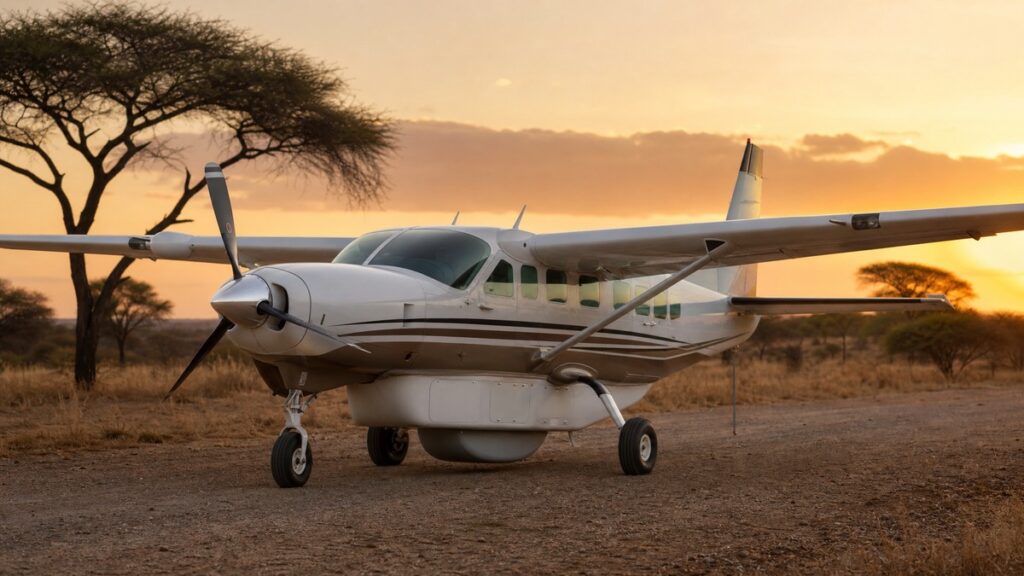
The Cessna Grand Caravan EX is the benchmark aircraft for destinations no jet can reach: gravel, grass, sand and snow runways, Norwegian fjords, Greek islands, African lodges. PT6A-140 engine, 9 passengers, underbelly cargo pod, 200 ft ground roll capability. The only credible option when the airfield has no paved runway.
The Cessna Grand Caravan EX is what you charter when the destination matters more than speed. Built by Cessna (Textron Aviation), it is the most versatile utility turboprop in the world — over 2,800 examples in service since 1986, from regional FedEx feeders to humanitarian NGOs and from African safari lodges to Greek island airlines. Its PT6A-140 engine of 867 shp and reinforced landing gear let it land on gravel, grass, sand or packed snow.
The Grand Caravan EX cabin (5.05 m × 1.63 m × 1.37 m) seats 9 passengers in commuter layout or 6-8 in executive club layout. Its cabin width (1.63 m) is more generous than a PC-12 or a King Air, and the large rear cargo door (1.25 m × 1.32 m) accepts skis, windsurfers, dive gear or cross-country ski equipment. The underbelly cargo pod adds 3.20 m³ of hold. It is the benchmark aircraft for families travelling on safari, location film crews, expedition operators and transfers to remote lodges.
With 1,070 nm (1,982 km) of range at 344 km/h cruise, the Grand Caravan EX covers Barcelona-Ibiza, Athens-Mykonos, Geneva-Lyon or Edinburgh-Stornoway non-stop. Its absolute minimum runway is 625 m on hard surface, but it is certified for grass or gravel strips under 500 m in some conditions. Operators typically bill £2,400 to £3,200 per hour, the lowest in the executive turboprop segment. Empty legs are less frequent but Greek-island and Norwegian operators regularly offer them in low season (October-April).
Practical information
- Category: Single-engine utility turboprop — remote destinations, unpaved runways
- Range: 1,982 km (1,070 nm) — Athens-Mykonos, Geneva-Lyon, Barcelona-Ibiza
- Cruise speed: 344 km/h (185 kt) — slower than a PC-12 but more accessible
- Minimum runway: 625 m on hard surface; grass and gravel strips accepted
- Cabin: 5.05 m × 1.63 m × 1.37 m — up to 9 passengers + cargo pod
- Equipment: large cargo door, 3.20 m³ underbelly pod, air conditioning; Wi-Fi optional
- Indicative price: £2,400 to £3,200 per hour — the most affordable in the segment
- Empty legs: Moderate, mainly on Greek islands, Norwegian fjords, African safari
Frequently asked questions about the Cessna Grand Caravan EX
A Grand Caravan EX charter costs between <strong>£2,400 and £3,200 per hour</strong>, the lowest in the executive turboprop segment. An Athens-Mykonos with 6 passengers typically comes in at <strong>£3,000 to £4,000</strong> one-way; an Edinburgh-Stornoway around <strong>£4,000 to £5,000</strong>. The Grand Caravan is often the cheapest aircraft available for remote island destinations where no jet can land.
The Grand Caravan EX seats <strong>up to 9 passengers</strong> in commuter configuration (shuttle seats in 2 rows of 4-5) or <strong>6 to 8 passengers</strong> in executive layout with facing club seats and a central tablet. The 1.63 m cabin width is more generous than a PC-12 or a King Air, allowing families with children or teams carrying musical instruments, photo gear or bulky sports equipment.
The Grand Caravan EX offers <strong>1,982 km (1,070 nm) of range</strong>, enough for most European regional and island routes. At 344 km/h cruise, it covers Athens-Mykonos in 30 minutes, Barcelona-Ibiza in 45 minutes, Geneva-Lyon in 40 minutes, Edinburgh-Stornoway in 1 h 10. Its modest speed compared to a PC-12 (537 km/h) is offset by its unique ability to land where no other aircraft can.
This is its biggest advantage: the Grand Caravan EX is certified for operations on <strong>gravel, grass, sand, packed snow</strong> in addition to paved runways. Its minimum runway on hard surface is <strong>625 m</strong>, but on unprepared surface it can take off from 500 m. That opens access to destinations like African safari lodges, smaller Greek islands (Schinoussa, Astypalaia), Norwegian fjords, and some Cycladic and Caribbean island runways (Mustique, Saba) totally inaccessible to pure jets and even to a PC-12 in some conditions.
The Grand Caravan EX cabin (5.05 m × 1.63 m × 1.37 m) prioritises utility over luxury. Reclining leather seats, efficient air conditioning, panoramic windows, USB and 110 V outlets as standard. Closed lavatory available as option (chemical), Wi-Fi optional depending on operator. Cabin noise is higher (82-86 dB) than on a PC-12 NGX, since the aircraft is unpressurised and cruises at 3,000-4,500 m altitude. That remains tolerable on flights under 90 minutes — the majority of Grand Caravan missions.
Both are single-engine turboprops but serve opposite missions. The <strong>Grand Caravan EX</strong> (344 km/h, 1,982 km range, £2,400/h) is unpressurised and slower, but it lands on gravel, grass or sand strips inaccessible to any other private aircraft. The <strong>PC-12 NGX</strong> (537 km/h, 3,334 km range, £3,000/h) is pressurised, faster and more comfortable, but requires a hard runway. Choose the Grand Caravan for remote island destinations, African lodges, Norwegian fjords or expedition areas; choose the PC-12 for standard executive routes and cabin comfort.