Turboprop jets 2026: the complete guide to private charter
Turboprops are private aviation’s most under-rated asset in 2026. They cost 30–50% less per hour than light jets, fly into more than seven thousand airports that no jet can use, and on regional missions under 600 nautical miles they often arrive at the door faster than a Citation or a Phenom. This guide explains exactly when a turboprop wins, how much it costs to charter one, and which aircraft to ask for.
From the legendary Pilatus PC-12 NGX flown by Fortune 500 CEOs to the ATR 72 connecting Mediterranean islands and the Beechcraft King Air 350 shuttling executives between regional plants, the turboprop segment has quietly become the smartest tool in private flying — provided you know how to use it.
What is a turboprop and why it matters in 2026
A turboprop is, in essence, a jet engine that drives a propeller. The same gas-turbine core that powers an Airbus is spun down through a reduction gearbox to turn a five-blade composite prop. The result combines the reliability and power-to-weight ratio of a turbine engine with the unmatched efficiency of a propeller in dense, low-altitude air.
For passengers, three things follow from that design choice. First, fuel burn drops dramatically below 25,000 feet where propellers operate best — 55–70 gallons per hour on a Pilatus PC-12 versus 180–220 gph on a comparable light jet. Second, the aircraft can climb steeply out of a 2,500-foot runway, opening a global network of small airports that pure-jet machines simply cannot use. Third, costs collapse: charter rates start around $2,000 per hour, with most executive turboprops in the $2,200–$3,500 band, versus $4,000–$6,000 for the cheapest light jet.
The trade-off is speed. A turboprop cruises at 280–360 mph; a Phenom 300 or a Falcon 6X moves at 460–560 mph. On a 1,500-mile transcontinental leg, that gap matters. On a 300-mile hop from Geneva to Saint-Tropez, with climb, descent and ground transfers factored in, it disappears completely — and the turboprop lands you 25 minutes closer to the villa, because it can use the small airfield that the jet cannot.
Turboprop vs jet: the differences that actually affect your trip
Headline numbers don’t tell the full story. The decision between a turboprop and a light jet depends on seven concrete operational variables.
| Criterion | Executive turboprop | Light jet | Who wins |
|---|---|---|---|
| Cruise speed | 280–360 mph | 460–510 mph | Jet (long missions) |
| Range | 1,000–1,800 nm | 1,500–2,200 nm | Roughly equal |
| Charter rate / hour | $2,000–$3,500 | $4,000–$6,000 | Turboprop |
| Fuel burn / hour | 55–110 US gal | 180–250 US gal | Turboprop |
| Runway needed | 2,000–4,000 ft | 4,000–6,000 ft | Turboprop |
| Airports accessible (global) | ~7,000+ | ~3,500 | Turboprop |
| Cabin altitude / pressurisation | 8,000 ft cabin @ 30,000 ft | 6,000 ft cabin @ 41,000 ft | Jet (long flights) |
| Service ceiling | 25,000–31,000 ft | 41,000–45,000 ft | Jet (weather) |
| Hot-and-high performance | Excellent | Degraded | Turboprop |
| Noise (cabin, dB) | 78–85 dB | 75–82 dB | Jet (marginal) |
| CO₂ per seat-mile (≤600 nm) | −15% to −30% | Baseline | Turboprop |
The short version: below 700 nautical miles, the turboprop usually wins on cost, environment and door-to-door time. Above 1,000 nm and especially across the Atlantic or over weather systems above 30,000 ft, the jet pulls ahead.
The 8 best turboprop aircraft for private charter in 2026
The global executive-turboprop fleet revolves around a small group of remarkable machines. Each was designed for a different mission profile — choosing the right one for your trip is the single biggest lever you have over comfort and cost.
| Aircraft | Type | Pax | Range (nm) | Speed | Hourly rate | Best for |
|---|---|---|---|---|---|---|
| Pilatus PC-12 NGX | Single-engine | 6–8 | 1,800 | 290 kt | $2,200–$2,800 | Versatile workhorse, short fields, family travel |
| Beechcraft King Air 350 | Twin-engine | 7–9 | 1,800 | 320 kt | $2,400–$3,200 | Executive shuttle, mountain routes |
| Beechcraft King Air 250 | Twin-engine | 7–8 | 1,720 | 310 kt | $2,200–$2,900 | Regional business travel |
| Daher TBM 960 | Single-engine | 5–6 | 1,730 | 330 kt | $1,800–$2,400 | Fastest single, owner-flown segment |
| Cessna Grand Caravan EX | Single-engine | 8–9 | 1,070 | 185 kt | $1,500–$2,200 | Unpaved strips, islands, bulky cargo |
| Piaggio Avanti EVO | Twin pusher | 7–8 | 1,720 | 402 kt | $3,200–$4,200 | Fastest turboprop, Italian style |
| Bombardier Dash 8 DHC8-300 | Twin-engine regional | 30–50 | 900 | 287 kt | $4,500–$6,500 | Groups, sports teams, large family events |
| ATR 72-600 | Twin-engine regional | 40–70 | 825 | 275 kt | $5,500–$7,500 | Charter groups, island networks |
Pilatus PC-12 NGX — the benchmark single-engine
The Pilatus PC-12 NGX is, by almost any measure, the most successful executive turboprop ever built. More than two thousand are flying worldwide, from Australian outback medevac fleets to Manhattan hedge-fund commutes. Its single Pratt & Whitney PT6E-67XP engine delivers 1,200 shp through a five-blade composite propeller; the cabin runs 17 ft long and 5 ft wide, accommodating six passengers in club-four-plus-two layout with a fully enclosed lavatory and a baggage door large enough for skis, golf bags or full-size road bikes. Range tops 1,800 nm — enough to cross half a continent in one leg.
Beechcraft King Air 350 — the twin-engine standard
Where the Pilatus rules the single-engine class, the King Air 350 has been the boardroom shuttle of choice in North America and Europe for three decades. Its two PT6A-60A engines provide engine-out redundancy that matters on overwater or mountain routes — essential for transfers over the Alps to Courchevel, Megève or St Moritz where weather can turn quickly. The 350’s “double club” layout seats eight in two facing groups of four, with a 360-mph cruise that closes the gap with very-light jets.
Cessna Grand Caravan EX — the utility workhorse
The Grand Caravan EX is what you charter when destination matters more than speed. A reinforced landing gear, 200-foot ground-roll capability and an underbelly cargo pod let it land on gravel runways in Greek islands, Norwegian fjords or African game lodges that even a King Air cannot reach. With nine passengers in commuter seats and 870 nautical miles of range, it is the workhorse of remote regional charter — and the only meaningful option for groups travelling to airfields without paved runways.
Bombardier Dash 8 DHC8-300 A — the group turboprop
For sports teams, music tours, large extended families or corporate offsites of thirty to fifty people, the Dash 8 DHC8-300 A changes the economics completely. Two Pratt & Whitney PW123 engines drive four-blade Hamilton Standard propellers, lifting a 50-seat regional airliner over short runways at altitude airports the equivalent narrowbody jet would refuse. Hourly rates of $4,500–$6,500 translate to roughly $100–$150 per passenger per hour — less than business-class commercial — with the door-to-door advantages of private operation.
How much does it cost to charter a turboprop in 2026?
Turboprop charter pricing follows the same logic as any private aircraft: a base hourly rate, plus repositioning, plus airport fees, plus catering and ground handling. The base rate is what differs most dramatically from jets.
| Aircraft class | Base hourly rate (2026) | 3-hour example trip total | Best route length |
|---|---|---|---|
| Light turboprop (Piper M600, TBM 960) | $1,800–$2,400 | $6,000–$8,500 | 200–700 nm |
| Mid-size single turboprop (Pilatus PC-12 NGX) | $2,200–$2,800 | $7,500–$10,500 | 300–900 nm |
| Executive twin turboprop (King Air 250/350) | $2,400–$3,500 | $8,500–$12,000 | 250–900 nm |
| Fast twin turboprop (Piaggio Avanti EVO) | $3,200–$4,200 | $11,000–$14,500 | 400–1,200 nm |
| Regional turboprop airliner (Dash 8, ATR 72) | $4,500–$7,500 | $15,000–$25,000 | 200–800 nm, groups 30+ |
Real route examples with all-in pricing
| Route | Distance | Flight time | Recommended aircraft | Indicative all-in price |
|---|---|---|---|---|
| Geneva → Nice (Côte d’Azur) | 165 nm | 0:55 | King Air 350 | €5,500–€7,500 |
| London Farnborough → Le Bourget | 185 nm | 1:05 | Pilatus PC-12 NGX | €5,500–€7,500 |
| Nice → Paris Le Bourget | 365 nm | 1:35 | King Air 350 | €7,500–€10,000 |
| Saint-Tropez → Paris | 410 nm | 1:45 | Pilatus PC-12 NGX | €8,000–€11,000 |
| Bordeaux → Lyon | 235 nm | 1:10 | King Air 250 | €5,500–€7,500 |
| Milan → Cannes | 165 nm | 0:50 | Piaggio Avanti EVO | €6,500–€8,500 |
| Barcelona → Ibiza | 140 nm | 0:45 | Cessna Grand Caravan EX | €4,500–€6,000 |
| Athens → Mykonos | 95 nm | 0:35 | King Air 350 | €4,000–€5,500 |
| Munich → St Moritz (Samedan) | 155 nm | 0:55 | Pilatus PC-12 NGX | €5,500–€7,500 |
| Rome → Olbia (Sardinia) | 185 nm | 1:00 | King Air 250 | €5,000–€7,000 |
Compare those to the equivalent light-jet quotes — see our full breakdown of private jet charter pricing for 2026 — typically 40–60% higher than the turboprop on every leg under 500 nautical miles.
Where turboprops beat jets: the 7,000-airport advantage
The single most important number in this guide is 7,000. That is, roughly, the count of airports worldwide that a Pilatus PC-12 or a King Air can use, and that almost every executive jet cannot. Jets typically require 4,000 feet of paved runway; turboprops fly out of 2,500-foot grass strips. That difference rewrites the geography of private travel.
In the Alps, that means landing at Samedan (the airfield for St Moritz, sitting at 5,600 ft elevation) or at Courchevel’s 1,762-foot ski strip — pure-jet operations into Courchevel are forbidden by law. In the Greek islands, it means direct service into Skiathos, Astypalaia or Kithira instead of a 90-minute boat from Athens. In the Caribbean, it means St Barts (where the runway is 2,170 ft and bordered by a hillside), Mustique, or Saba’s notorious 1,300-foot strip.
For corporate operators, the same advantage applies to industrial Europe: a King Air can fly directly into Vannes, Quimper, Dijon, Verona Boscomantico or Cuneo, putting the chief executive 15 minutes from the plant instead of 90 minutes from the regional jet airport.
Hot, high and tough: the operational edge
Turboprops outperform jets in conditions where jet engines struggle. Three physical effects combine to give a propeller-driven aircraft a remarkable advantage on demanding airfields.
Hot and high. A jet engine generates thrust by compressing dense air. As ambient temperature rises or altitude increases, the air entering the engine thins out — jet thrust collapses. A propeller, by contrast, recovers efficiency from sheer surface area. The result is that turboprops fly into airports like Aspen (7,815 ft), St Moritz Samedan (5,600 ft), Cuzco (10,860 ft) or summer Phoenix — routinely and at full payload — while jets must offload passengers, fuel or both.
Short-field performance. A turboprop can use beta range to reverse thrust on the propeller, reducing landing rollout to as little as 1,000 ft. This is the technology that lets a Pilatus PC-12 land on the 1,762-foot Courchevel altiport, the world’s most demanding commercial airstrip, with a margin to spare.
Bad weather resilience. Modern turboprops carry inflatable de-icing boots on the wing leading edges, electrically heated propellers, windshield heat and full weather radar. Their lower cruise altitude means they fly through weather rather than over it — but with avionics specifically designed for IFR operations in difficult conditions, including Garmin G3000 synthetic vision and predictive windshear warning.
The cabin experience: noise, vibration, comfort
The biggest myth about turboprops is that they are loud, cramped and uncomfortable. That was true twenty years ago. In 2026, it is not.
Cabin noise on a modern Pilatus PC-12 NGX measures 78–82 dB at cruise — slightly lower than a typical Airbus A320 (85–95 dB) and within five decibels of a brand-new light jet. Five-blade composite propellers spin slower than the four-blade aluminium predecessors, generating significantly less acoustic energy. Active noise-cancellation systems, fitted as standard on the King Air 360 and as options on the Dash 8 Q400, push interior noise down to 72 dB.
Cabin dimensions on the executive turboprop fleet have closed the gap with light jets:
- Pilatus PC-12 NGX: cabin height 4.9 ft, width 5.0 ft, length 16.1 ft — wider than a Phenom 100.
- King Air 350: cabin height 4.8 ft, width 4.5 ft, length 19.5 ft — comparable to a Citation CJ3.
- Piaggio Avanti EVO: cabin height 5.8 ft (stand-up), wider than any light jet, with a true club layout.
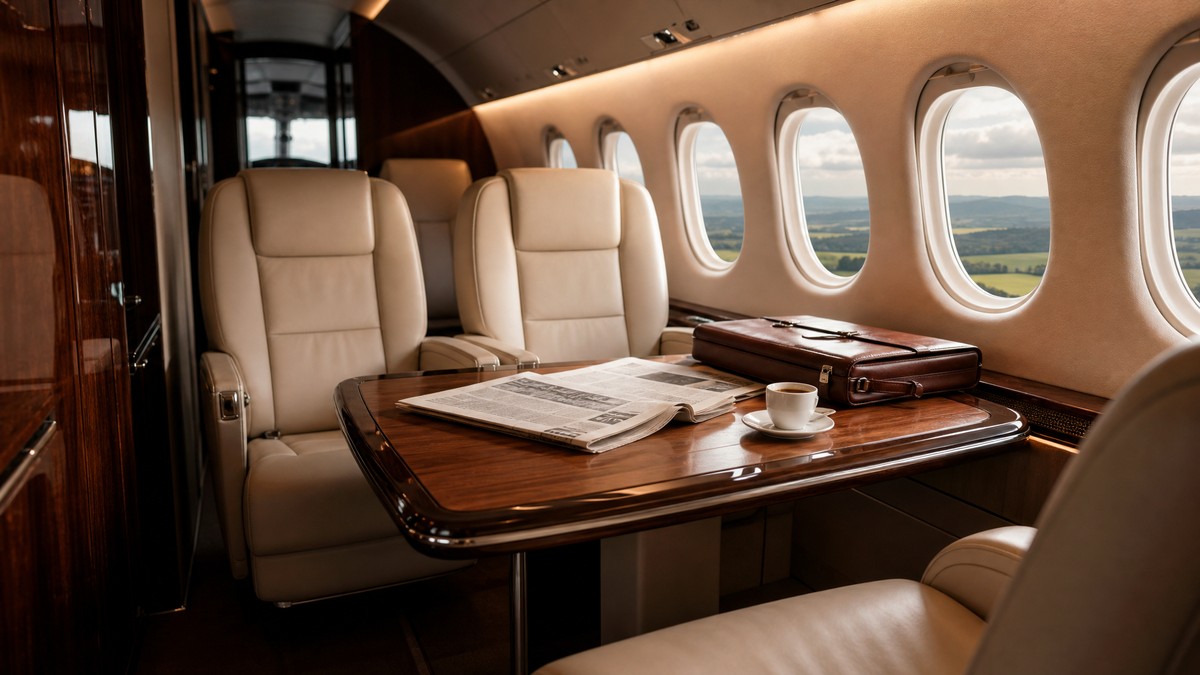
Wi-Fi via Gogo Avance L5 or Starlink Aviation is now standard on most charter turboprops. So are leather seats with full recline, foldable tables, USB-C and 110-V power, and individual climate control. The Pilatus PC-12 NGX even offers a “carbon” interior package with woven-carbon trim and Alcantara headliners that rivals anything in the light-jet segment.
Carbon footprint and sustainable aviation fuel
For corporates with ESG reporting obligations and family offices with carbon-conscious principals, the turboprop has become the most defensible choice for regional travel. On a 400-nautical-mile mission, a Pilatus PC-12 emits roughly 15–30% less CO₂ per seat-mile than a comparable light jet, simply because it burns one-third of the fuel.
The Pratt & Whitney PT6A family — by far the most-used turboprop engine in business aviation, with over fifty thousand units produced — is certified to operate on 50% Sustainable Aviation Fuel (SAF) blends today, with 100% SAF certification expected by 2028. On routes under 600 nm, this gives the turboprop a credible decarbonisation pathway that simply does not exist for light jets on the same missions.
When you should still choose a jet
The turboprop is not the universal answer. Three flight profiles strongly favour a light or midsize jet:
- Anything over 1,200 nautical miles. Speed compounds on longer legs. A Citation CJ3 will reach Paris from Madrid 35 minutes faster than a King Air 350; on London–Athens, the difference balloons to nearly two hours. Time savings at scale dominate.
- Weather and high-altitude routes. A Phenom 300 cruises at 45,000 ft, comfortably above almost every weather system in Europe. A King Air maxes out at 35,000 ft — still excellent, but on extreme storm days, the jet wins on schedule reliability.
- Long flights with passengers who need to walk. A stand-up cabin like the Citation Latitude or the Pilatus PC-24 makes a difference on missions over three hours. Most turboprops require seated travel throughout.
For everything else under 700 nm — which is two-thirds of all private flights in Europe and North America — the turboprop is the smarter choice.
How to charter a turboprop in 2026
Three rules will save you money and friction.
Specify the aircraft, not the category. “Turboprop” alone is too vague — operators will quote you anything from a 5-seat Piper Cheyenne to a 50-seat ATR. Ask for the specific aircraft type that fits your mission: Pilatus PC-12 NGX for executive comfort, King Air 350 for twin-engine peace of mind, Grand Caravan for unpaved or remote, Dash 8 for groups.
Match the airport to the aircraft. The turboprop’s biggest advantage is which airport it can use. Tell your broker the actual destination — the villa address, the chalet, the corporate site — not just the nearest commercial airport. Often there is a small airfield 20 minutes closer that only a turboprop can reach.
Hunt empty legs. Turboprops reposition constantly between regional airfields, and empty-leg pricing on the King Air and PC-12 segment can drop 40–70% below standard charter rates. Subscribe to operator empty-leg alerts and stay flexible on your departure window — our guide to low-cost private jet travel covers six other tactics that work especially well in the turboprop segment.
Frequently asked questions about turboprop jets
Is a turboprop a jet?
Strictly speaking, a turboprop is a turbine engine that drives a propeller — the engine itself is a jet engine, but the thrust comes from the propeller, not from the exhaust. In private aviation marketing, “turboprop jet” is used loosely to describe executive turboprop aircraft like the Pilatus PC-12 or the King Air series. From a passenger experience, regulation and safety standard standpoint, modern executive turboprops are treated as equivalent to private jets.
How safe are turboprops compared to jets?
Charter turboprops operating under FAA Part 135 or EASA equivalent rules have safety records statistically indistinguishable from those of light jets. Two-pilot operation is standard on every executive charter, even on single-pilot-certified aircraft. The Pratt & Whitney PT6A engine that powers most of the fleet has accumulated over 400 million flight hours since 1963, with an in-flight shutdown rate of roughly one per 350,000 hours — making it one of the most reliable aircraft engines ever built.
How many passengers can a turboprop carry?
Executive turboprops typically carry 6–9 passengers in business configurations. The Pilatus PC-12 NGX seats six in standard layout (eight maximum). The King Air 350 seats up to nine. For larger groups, the Dash 8 DHC8-300 takes 30–50 passengers and the ATR 72 takes up to 70 — both bookable as private charter for sports teams, music tours and corporate events.
Are turboprops noisier than jets in the cabin?
Modern executive turboprops cruise at 78–85 dB cabin noise — within a few decibels of comparable light jets. The Pilatus PC-12 NGX’s five-blade Hartzell composite propeller specifically targets noise reduction; active noise cancellation on the King Air 360 closes the gap further. Most passengers describe the experience as comparable to a Cessna Citation light jet on flights of 60–90 minutes.
What is the range of a turboprop?
Executive turboprop range varies from 800 nm on a Cessna Grand Caravan EX to 1,800 nm on a Pilatus PC-12 NGX or King Air 350. That covers virtually every intra-European route, and most regional North American flights. For transatlantic or trans-Pacific flying, a jet is required — see our long-haul private jet guide for the aircraft and routes that work over 1,500 nm.
Can a turboprop land at small airfields?
Yes — this is the segment’s biggest competitive advantage. A Pilatus PC-12 needs roughly 2,600 ft to take off and 2,165 ft to land. A King Air 250 requires 2,500 and 2,200 ft respectively. By comparison, a Citation CJ3 needs 3,180 ft just to land. That difference opens roughly 7,000 additional airports worldwide, including grass strips, mountain altiports, island runways and unpaved bush fields that pure-jet operations cannot access.
How much does it cost to charter a turboprop?
Executive turboprop charter rates in 2026 start at around $2,000 per hour for a TBM 960 or Piper M600, climb to $2,200–$2,800 for a Pilatus PC-12 NGX, and reach $2,400–$3,500 for a King Air 350. A typical 3-hour regional mission costs $6,000–$12,000 all-in. Compare to $15,000–$25,000 for the equivalent light-jet quote.
Can a turboprop fly in bad weather?
Yes. Modern charter turboprops are equipped for known-icing operations with pneumatic de-icing boots, heated propellers, windshield heat and full weather radar. They cruise lower than jets so spend more time in weather, but their avionics suite — typically Garmin G1000/G3000 with synthetic vision — is specifically designed for IFR flight in challenging conditions. Operationally, dispatch reliability is comparable to that of light jets.
Which is the best turboprop for private charter?
The Pilatus PC-12 NGX is the most-chartered executive turboprop globally, combining a single-engine PT6E-67XP, an 1,800 nm range, a 6–8 passenger cabin and unmatched short-field performance. For twin-engine redundancy on mountain or overwater routes, the Beechcraft King Air 350 is the standard. For unpaved or remote destinations, the Cessna Grand Caravan EX. For groups of 30+, the Bombardier Dash 8 DHC8-300 A.
Ready to charter a turboprop?
Whether you need a Pilatus PC-12 NGX for a weekend in the Alps on routes like Paris–Courchevel or Geneva–Nice, a King Air 350 to shuttle a board between regional plants on the London–Paris corridor, or a Dash 8 DHC8-300 A to fly forty guests to a corporate retreat, SmartPrivateJet curates a global network of certified turboprop operators and delivers a transparent quote within minutes. Get in touch to discuss your route — and find out exactly how much you save by choosing the right aircraft.