
Travelling with your team: optimising a group business trip by private jet
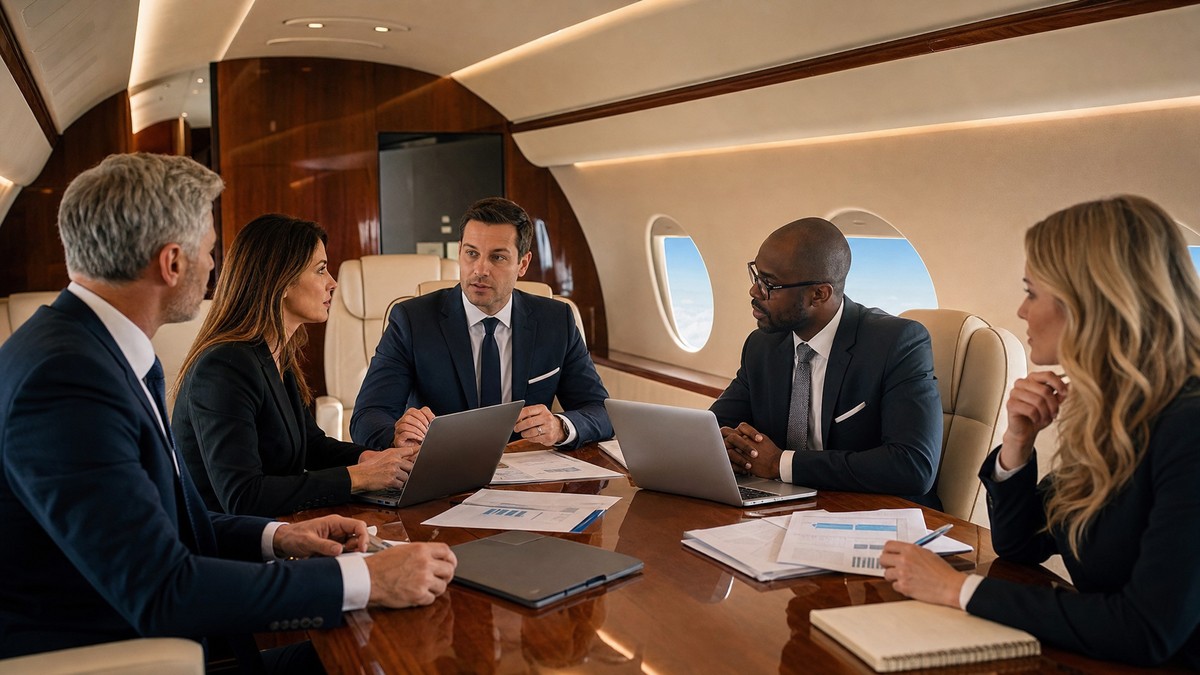
When a team of six executives takes a commercial Paris–Milan flight for a 9 a.m. meeting, the operation looks something like this: six separate taxis to CDG, arriving 1h30 before departure, one member delayed at security, another missing a bag in the hold, seats scattered across three different rows. The preparation meeting planned during the flight never happens. On arrival, everyone takes their own taxi. Outcome: six hours lost, a team out of sync, and business-class tickets that often come close to the price of a private charter for the whole group.
This guide analyses when and how a team trip by private jet becomes a rational decision — not a luxury — and how to get the most out of it operationally.
The financial calculation few companies actually do
The instinctive comparison is the price of an individual ticket multiplied by the number of team members. This is an analytical error. The correct calculation integrates four real costs:
1. Lost time
A commercial Paris–Brussels trip actually represents 3h30 to 4 hours per person (transit, check-in, connections, baggage collection). With a private terminal such as Le Bourget, arriving 15 minutes before take-off is the norm. The same total journey drops to 2 hours. For a team of six people whose hourly cost is €200 to €500, the productivity differential is quantifiable.
2. Logistics coordination
Six people = six bookings, six different availabilities, six possible complications (delay, strike, cancellation). A team private jet flight is a single booking, a single schedule, a single arrival. The logistical desynchronisation of a commercial team trip can represent several additional hours of administrative work.
3. Confidentiality
Discussing an acquisition, a restructuring or a strategy in a commercial terminal, in a queue or in seats adjacent to strangers is a real risk. On a private jet, the cabin is entirely private. No third parties are present — neither in the cabin nor at the dedicated private terminal.
4. The team’s condition on arrival
An executive coming off a connecting overnight commercial flight is not in the same cognitive state as after a private jet night flight with a flat bed. On a Paris–New York journey for an 8 a.m. presentation the next day, this difference can directly affect the outcome of the meeting.
The financial tipping point
For teams of 4 to 6 people, the economic tipping point often falls between long-haul business-class tickets and a short-haul private charter — the rates are comparable once total costs are factored in. Beyond 8 people, the comparison becomes even more favourable to private charter.
| Team size | Commercial business class (total) | Private jet charter (estimate) | Advantage |
|---|---|---|---|
| 4 people — Paris–London | €3,200 – €6,000 | €4,500 – €7,000 | Slightly more expensive, but private terminal + flexibility |
| 6 people — Paris–Milan | €5,400 – €9,000 | €6,000 – €9,000 | Equivalent price, significant time advantage |
| 8 people — Paris–Frankfurt | €8,000 – €14,000 | €7,000 – €10,000 | Private jet often cheaper and faster |
| 12 people — Paris–Dubai | €18,000 – €36,000 | €35,000 – €55,000 | Commercial cheaper, but time and productivity loss |
Which aircraft for which team size?
The choice of aircraft depends directly on the size of the group, the distance and the working conditions desired on board.
Teams of 4 to 6 people — The Light Jet or Midsize
For a team of 4 to 6 people on intra-European routes, a Light Jet (Embraer Phenom 300, Cessna Citation CJ3+) or a Midsize (Cessna Citation XLS+, Hawker 800XP) is sufficient. The cabin offers enough space for an informal meeting, laying out documents and working on a laptop. These aircraft cover all European routes in 1 to 3 hours. Indicative rate: €3,500 – €6,500/hr.
- Embraer Phenom 300E: 6–7 seats, high-speed Wi-Fi, 1.50 m cabin height, 2,010 nm
- Cessna Citation CJ4: 7–8 seats, high performance on short runways, 2,165 nm
- Cessna Citation XLS+: 8–9 seats, excellent working cabin, 2,100 nm
Teams of 7 to 12 people — The Super Midsize or Heavy Jet
Beyond 7 people, a Super Midsize (Bombardier Challenger 350, Cessna Citation Longitude) or a Heavy Jet (Gulfstream G550, Bombardier Challenger 650) is required. The wider cabin allows for a real conference table, two distinct zones (meeting + rest) and enough space for documents and presentation materials. Indicative rate: €6,000 – €12,000/hr.
- Bombardier Challenger 350: 9–10 seats, 1.83 m cabin height, Ka-band Wi-Fi, 3,200 nm
- Cessna Citation Longitude: 9–12 seats, one of the quietest cabins in its category, 3,500 nm
- Bombardier Challenger 650: 10–12 seats, spacious cabin, ideal for long meetings, 4,000 nm
Teams of 13 to 19 people — The Large Jet or VIP Airliner
For groups of more than 12 people, two options arise. Either a Large Jet such as the Gulfstream G650 or Bombardier Global 7500 (16–19 seats, multiple zones), or a VIP-configured airliner — a Boeing 737 or Airbus A319 reconfigured with grand-comfort seating, a bar and a conference room. These aircraft are available for charter through specialist brokers for groups of 20 to 100 people.
Turning the flight into productive working time
The in-flight meeting: how to organise it
A two-hour Paris–Milan flight represents 90 minutes of available working time after boarding formalities. To get the most out of it:
- Circulate the agenda before boarding. Each team member arrives with the context in hand, not with preliminary questions.
- Use the central conference table (available on most midsize and heavy jets) to share documents and diagrams. Avoid meetings on laptops turned towards the other person — difficult to read in a cabin.
- Schedule catering service outside decision-making sequences. A meal served during a strategic discussion fragments attention. Plan essentials before or after.
- Appoint a session facilitator who manages time and speaking turns — exactly as in a ground meeting.
Connectivity: insist on broadband
Not all aircraft have equivalent connectivity. For in-flight video calls, insist on Ka-band or Ku-band — Inmarsat Swift Broadband or Iridium systems are insufficient for HD video calls. Ask the broker or operator explicitly for the speeds available on the proposed aircraft. Recent jets (Challenger 350, Citation Longitude, Global 5500 and above) offer speeds of 15 to 25 Mbps, sufficient for 4 to 6 simultaneous video participants.
Working and rest zones
On a flight of over 4 hours with a team, consider alternating:
- Forward zone: conference and work — table, power points, shared screens if available
- Rear zone: individual rest — for members not involved in the current sequence or who need to arrive rested
On heavy jets such as the Falcon 8X or Global 7500, ask the operator to configure the cabin in distinct zones at the time of booking. This configuration is generally without surcharge.
Confidentiality of exchanges
In flight, sensitive documents can be presented, discussed and handled with no risk of being seen by third parties. For digital exchanges, verify that the on-board Wi-Fi connection uses an encrypted network — some operators offer integrated VPNs in the on-board system. For the most sensitive discussions, flight mode remains the only absolute guarantee against external eavesdropping.
Logistics of a team trip: points to watch
The departure airport
For a Paris-based team, Le Bourget (LBG) is the default choice — Europe’s leading business airport, dedicated terminal, no queues, easy parking. For teams in southern Île-de-France, Toussus-le-Noble or Villaroche are alternatives that reduce ground transit time. For groups of more than 15 people, certain private terminals at CDG (terminals G or J) may be used.
Luggage management
The hold of a midsize jet is more limited than a commercial aircraft. For a group of 8 people with work bags and presentation materials, plan ahead: a Light Jet will often be too limited. A Challenger 350 or Citation Longitude offers holds of 170 to 210 litres — sufficient for cabin-sized bags and some briefcases. If your team is travelling with heavy equipment (samples, exhibition stands), specify this at the time of booking.
Customs and immigration formalities
For flights outside the Schengen area (UK, USA, Middle East), formalities take place in the private terminal — not in a common terminal. Waiting times are incomparably shorter. For flights to the United States, CBP (Customs and Border Protection) formalities can be submitted electronically in advance. For the Middle East, certain airports reserve dedicated lanes for private jet passengers.
Business catering
A working flight is not a leisure flight. Catering must be planned around the on-board schedule: light snacks to maintain concentration during the meeting, a full meal if the duration requires it, hot drinks and water throughout. Avoid heavy or alcoholic menus before an important meeting on arrival. Most operators offer customisable catering 24 to 48 hours before the flight.
The most common use cases
Due diligence and site visits
An M&A team that needs to visit three factories in three countries over two days cannot organise this commercially. The private jet is the standard tool in these situations: departure at the chosen time, landing at regional airports close to the sites, direct return without going through a hub. Cost: often lower than the sum of business-class tickets plus additional hotel nights incurred by connecting flights.
Executive seminar or annual kickoff
Moving 12 to 20 executives for a two-day seminar to a European destination (Lisbon, Vienna, Copenhagen) by private jet radically simplifies logistics: one flight, one schedule, a group arrival. Time spent together in flight can be used as a first moment of team cohesion. Paris–Lisbon for a group of 12 on a Challenger 650 comes to approximately €35,000–€45,000 — comparable to 12 return business-class tickets.
Investor roadshow or client pitch
A financial roadshow typically involves 3 to 5 cities in 2 days. Only the private jet allows this operational density: departing as soon as the previous meeting ends, landing as close as possible to the next appointment, reducing transit time to its minimum. The team stays synchronised, prepared and arrives in front of each client in the best possible condition.
Transporting talent or athletes
A professional sports team, a performing arts troupe or a group of artists on tour enjoy the same advantages: flexible departures after events, privacy, no contact with the general public, space suited to physical rest after competition.
FAQ — Team travel by private jet
From how many people does a private jet become cost-effective for a team?
For intra-European flights, the economic tipping point is generally from 4 to 6 people in business class, once total costs are factored in (tickets + lost transit time + coordination). At 8 people or more, private charter is often cheaper than group business-class tickets, for equivalent journey times.
How do you organise a group private jet flight?
The standard process: (1) define the group size, date, itinerary and specific requirements (equipment, catering, connectivity), (2) contact a broker or operator directly for a tailored quote, (3) confirm the aircraft and validate the passenger list (required for international flights). For a group of 6 to 12 people, brokers such as AeroAffaires or LunaJets respond in under an hour.
Can you hold a real meeting on board a private jet?
Yes, on any midsize or larger jet. The central conference table, high-speed connectivity, calm acoustics and absence of third-party passengers create the conditions for an effective meeting. Heavy jets (Challenger 650, Global 6500) offer multi-zone cabins allowing the working area and rest area to be separated.
What documents are required for an international team flight?
The same as for a commercial flight: a valid passport for non-Schengen flights, a visa if required for the destination. The operator or broker collects passenger information (full name, date of birth, passport number) generally 24 to 48 hours before the flight for submission to the authorities. No common check-in or queues — formalities take place in the private terminal.
How do you compare the cost of a private jet team flight with business-class tickets?
Compare total cost, not the unit rate: business-class tickets (× number of people) + round-trip transit time (× average hourly cost of the team) + any additional hotel nights due to connections. For reference rates by route, our private jet rental prices guide gives ranges by aircraft category and journey.