
Inside a private jet: cabin, materials, technology, comfort…
Stepping through the door of a private jet is entering a world that most travellers only imagine through photographs. No queues, no packed overhead compartments, no assigned neighbour. Instead: a cabin that resembles a grand hotel lounge far more than an aircraft, conceived in its smallest details so that the journey itself becomes a destination.
But what does the interior of a private jet actually look like? The answer depends on the type of aircraft — a 4-passenger Very Light Jet has nothing in common with a Global 7500 crossing the Atlantic in a private suite. This feature takes you from the most understated cabin to the most extravagant interiors in the sky, zone by zone, material by material.
The cabin from the inside: a space designed like an apartment
Unlike an airliner where every square centimetre is optimised to accommodate the maximum number of seats, a private jet cabin is conceived in the opposite direction: to maximise the comfort of each passenger. The space is therefore generous, adaptable, and often organised into several distinct zones depending on the size of the aircraft.
The lounge zone: the heart of the cabin
This is the central element of every private jet. The armchairs — called “club seats” in business aviation parlance — are custom-made, in hand-stitched full-grain leather, with memory foam cushioning and precise adjustment mechanisms. They swivel, recline to the horizontal on medium and long-haul aircraft, and can face each other to recreate the atmosphere of a private lounge.
The seat pitch bears no comparison with commercial first class: expect 90 cm to 1.5 metres of pitch depending on the aircraft. Wide armrests incorporate seat controls, power sockets, USB ports and sometimes individual touchscreens. Tables in fine wood (walnut, ebony, zebrawood) unfold in one movement and offer enough surface to work on two screens simultaneously.
The galley: the kitchen at 12,000 metres altitude
On a light jet, the galley is a compact unit: coffee machine, integrated refrigerator, a few storage compartments. Sufficient for a Paris–London flight of 55 minutes with champagne and snacks.
On a midsize or super midsize, the galley becomes a genuine compact professional kitchen: convection oven, warming plates, full-size espresso machine, dishwasher, refrigerated wine cabinet. Catering is prepared by aviation-specialist caterers — some calling on Michelin-starred chefs — and packaged in hermetic containers adapted for altitude.
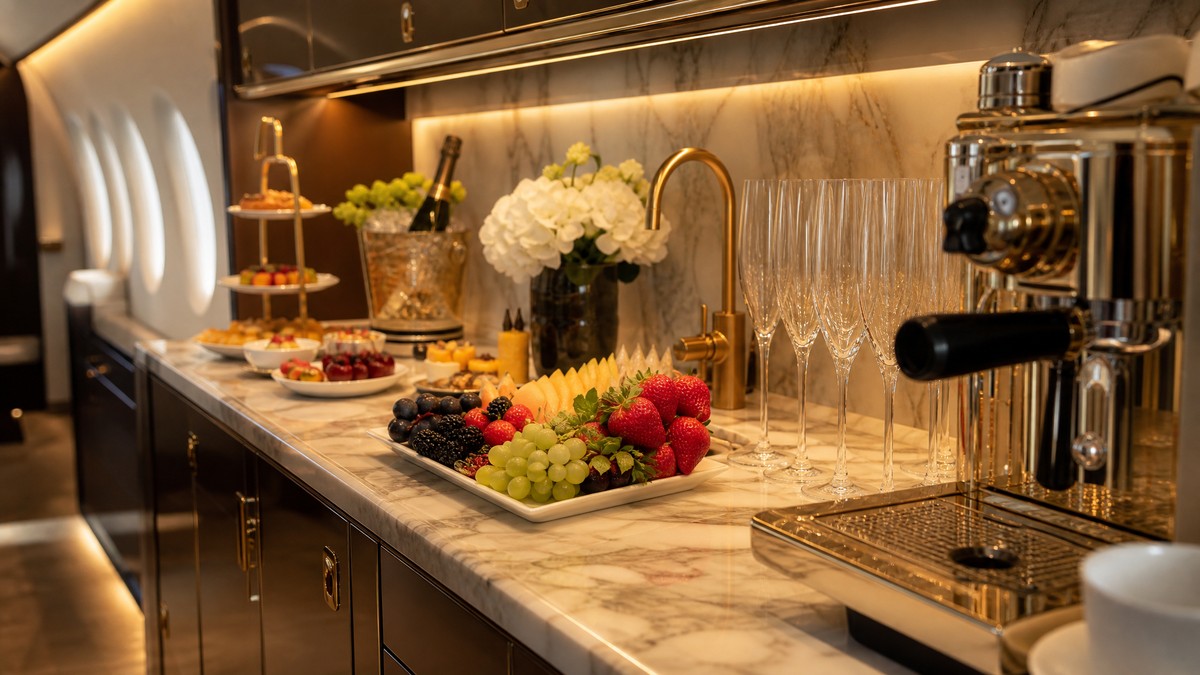
On premium long-haul jets, the galley can occupy a separate zone with full standing height, comparable to the kitchen of a well-appointed Parisian apartment. The Gulfstream G700, for example, features an “ultragalley” — their term — capable of preparing full hot meals for 19 passengers.
The bathroom: from plastic cubicle to private spa
All private jets have at least one bathroom. But the difference between a VLJ and an ultra long-range aircraft is striking.
On entry-level aircraft, the toilet remains functional: compact space, standard materials. Clean and private — that is their main advantage over commercial travel.
On premium aircraft — from heavy jets upwards — the bathrooms shift into an entirely different dimension. Carrara marble on vanity surfaces, brushed brass or gold-toned taps, integrated storage for luxury toiletries. Certain ultra long-range jets (Bombardier Global 7500, Gulfstream G700) feature an on-board shower — a technical feat in a pressurised space at 12,000 metres altitude, where the water supply is rationed (approximately 4 litres per shower).
Zone by zone: what each aircraft category conceals
| Category | Examples | Passengers | Cabin height | Typical interior features |
|---|---|---|---|---|
| Very Light Jet | Phenom 100, Citation M2 | 4–5 | 1.45 m | 4 leather seats, mini galley, compact toilet, optional Wi-Fi |
| Light Jet | Citation CJ4, Phenom 300 | 6–8 | 1.52 m | 6-seat lounge, work table, equipped galley, separate toilet |
| Midsize Jet | Citation Latitude, Learjet 75 | 7–9 | 1.83 m | Full stand-up height, convertible divan-beds, full galley, Wi-Fi, entertainment |
| Super Midsize | Challenger 350, Praetor 600 | 9–12 | 1.88 m | Wide-body cabin, rest zone, meeting zone, spacious bathroom, professional kitchen |
| Heavy Jet | Falcon 2000LXS, Global 5500 | 12–16 | 1.96 m | Several separate zones, double bed possible, two bathrooms, passenger suite, high-speed Wi-Fi |
| Ultra Long Range | Global 7500, Gulfstream G700, Falcon 10X | 14–19 | 2.03 m | Master bedroom suite, shower, private office, meeting room, full-size kitchen, lounge |
The materials: when the aircraft becomes haute couture
The interior of a premium private jet is the result of intense artisanal work, comparable to that of a couture house or a luxury coachbuilder. Specialist cabin completers — such as Lufthansa Technik, TAG Aviation or Comlux — work for months, sometimes years, on the configuration of a VIP aircraft.
Leather and textiles
Leather is ubiquitous in private jets, and its origin matters. The finest cabins use premium bovine or ostrich leather, tanned using artisanal Italian processes. Saddle-stitch seams are hand-sewn with silk or Kevlar thread for durability. Colours are chosen from personalised palettes — cream beige and ivory predominate, but some owners opt for bolder tones (military khaki green, midnight blue, deep burgundy).
Carpeting is also bespoke: New Zealand wool, hand-woven Axminster from England, or acoustic felt for aircraft focused on noise discretion.
Woodwork and panels
Wood is worked as veneer or in solid pieces depending on the zone. The most commonly used species: American walnut (warm, pronounced grain), Macassar ebony (dramatic black streaked with beige), zebrawood (bold, very graphic), white sycamore (bright, contemporary). These wood panels are dried, stabilised, then hand-lacquered with finishes designed to withstand pressure and humidity variations at high altitude.
Metals and finishes
Handles, taps, window surrounds and finishing trims are in anodised aluminium, chrome, brushed gold or titanium depending on the specification level. In the case of certain clients — particularly in the Middle East (Dubai, Riyadh, Abu Dhabi) — 24-carat gold is found on the sanitary fittings, taps and even ventilation grilles.
Lighting
Lighting is one of the most carefully crafted elements of the cabin. Premium jets feature fully programmable LED lighting systems capable of reproducing the natural day/night cycle to help combat jet lag. Light can change in colour, intensity and colour temperature during the flight — from blue morning light to orange sunset — to prepare the body for the local time at the destination.
On-board technology: connectivity and digital comfort
High-speed Wi-Fi
On-board Wi-Fi is now standard on all midsize-category aircraft and above. The most recent systems (Starlink Aviation, Viasat Ka-band) offer speeds of 100 Mbps or more, comparable to a ground-based fibre connection. HD video conferences, real-time downloads, financial trading sessions: all of this is possible at 12,000 metres altitude.
Cabin Management System (CMS)
Modern jets are equipped with a centralised cabin management system — a touchscreen (or smartphone application) from which passengers control:
- Lighting (intensity, colour, ambiance)
- Cabin temperature (zone by zone)
- Window shades (motorised on larger aircraft)
- The entertainment system (music, video, films)
- The seat (position, massage, heating)
- The call function for the cabin crew
Gulfstream was a pioneer with its integrated Cabin Management System (CMS), now emulated across the entire industry.
Entertainment and screens
On-board screens range from the 15-inch monitor integrated into the headrest to the wall of 4K screens spanning the entire forward bulkhead on prestige aircraft. Some ultra long-range jets feature retractable projectors with a deployable 60-inch screen. Entertainment libraries are loaded locally before the flight, with films, series, music and games available offline.
Telephony and secure communications
For business executives, certain jets feature encrypted telephony systems and secure communication suites, enabling confidential calls that cannot be intercepted in flight. These installations, initially reserved for government aircraft, are gradually becoming available in civilian VIP fleets.
The bedroom and rest areas
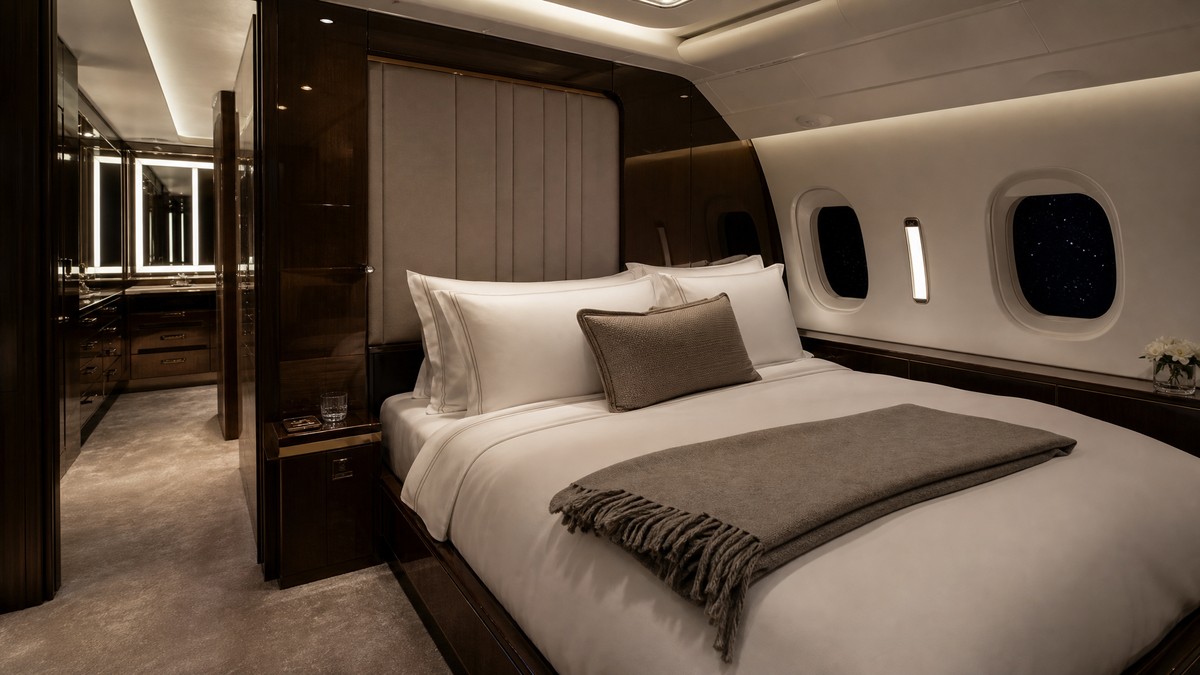
From heavy jets upwards, the concept of “rest in flight” changes radically. Convertible divan-beds are available from midsize aircraft — a bench seat that flattens to form a 180 cm berth. But it is on ultra long-range jets that genuine master suites are found.
The Bombardier Global 7500 offers a complete suite with a large-format bed (1.96 m), wardrobes, a full-length mirror and acoustic separation from the rest of the cabin. The Gulfstream G700 goes further still with a master bedroom featuring a lengthwise bed with a 7.5 cm mattress, palace-grade linen (500 thread-count cotton), cashmere blankets and goose-down pillows. The Dassault Falcon 10X, the French manufacturer’s flagship aircraft, offers a suite with a double bed, dressing room and independent bathroom with shower.
On a Paris–Tokyo or Paris–Los Angeles flight of 11 to 12 hours, the ability to sleep in hotel-grade conditions changes everything for decision-makers who need to be fully operational on landing.
The meeting zone: the office in the sky
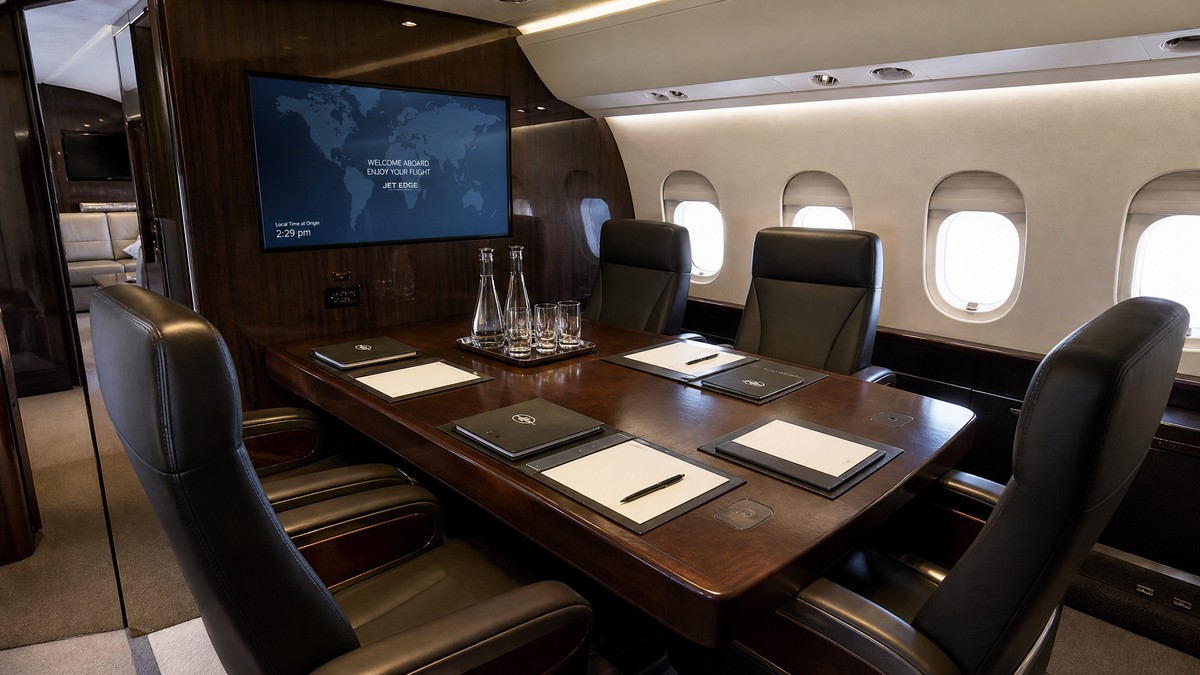
Business aviation takes its name from its primary purpose: travelling in order to work. Private jets integrate this dimension with sophisticated office configurations.
The standard configuration brings 4 armchairs around a central table, with power sockets, adjustable task lighting and a stable writing surface. On larger aircraft, this meeting zone can seat up to 8 people around a conference table, with an integrated presentation screen, video-conferencing systems and secure connectivity.
Confidentiality is absolute: no risk of being overheard by a neighbouring passenger or observed in an airport. For financial roadshows, merger and acquisition negotiations or executive briefings (see also: Paris Le Bourget, the reference business terminal), this confidentiality is as valuable as the seat itself.
The most spectacular interiors in the sky
Gulfstream G700: the new American benchmark
Entering service in 2022, the G700 redefines the standards. Its cabin — 16.1 metres long and 2.18 metres wide — features five distinct living zones, the ultragalley and a master suite with large-format bed. The 20 windows (the largest in the industry) flood the cabin with natural light. Range: 7,500 nm. Capacity: 19 passengers.
Bombardier Global 7500: the Canadian masterpiece
The Global 7500 holds the range record for production business jets (7,700 nm, Paris–New York or Paris–Sydney non-stop). Its master suite with double bed, separate lounge and premium kitchen make it an 18-metre flying apartment. Finishes are produced in partnership with renowned designers, including Hermès for certain special configurations.
Dassault Falcon 10X: French craftsmanship in the sky
Expected to enter service in 2026, the Falcon 10X is Dassault Aviation’s most ambitious aircraft. Its 2.03-metre-tall cabin — a class record — and its 4 distinct living zones position it against the best Gulfstream and Bombardier offerings. Dassault’s commitment: French materials, extreme acoustic engineering (below 52 dB in cruise), and complete personalisation in collaboration with leading Parisian interior design studios.
The VIP jets of heads of state and billionaires
Beyond production models, certain jets are flying works of art. The Airbus ACJ TwoTwenty or the Boeing BBJ (Business Jet) are commercial aircraft entirely refitted as VIP configurations: formal dining rooms, marble showers, royal suites, projection rooms. Some belong to Middle Eastern royal families and cost several hundred million euros in fit-out alone — sometimes as much as the aircraft itself. Details include champagne fountains, backlit glass floors, agate bathtubs and gold mosaic ceilings.
Personalisation: your interior, your signature
One of the least-known advantages of a private jet is total personalisation for owners. A buyer commissioning a new Gulfstream or Bombardier is presented with a “shell” — an empty fuselage — that can be fitted out 100% according to their tastes.
The process involves a specialist aeronautical design studio (Greenpoint Technologies, Jet Aviation Design, Fokker Services) which translates a vision into a certified interior space. The constraints are real: limited total weight, certified materials, vibration and pressure-variation resistance, access to technical equipment. But within these limits, everything is possible: personalised Pantone colours, monograms embroidered on each headrest, a spatialised sound system with Bowers & Wilkins speakers, or a partnership with a luxury hotel to reproduce its atmosphere exactly on board.
For charter aircraft, personalisation is more limited but operators offer catering, linen, flower and seasonal decoration options on request.
What passengers notice first
Pilots and cabin crew who welcome first-time private jet travellers consistently report a near-universal reaction: surprise at the silence. Modern private jets are designed for maximum acoustic insulation — between 52 and 58 dB of cabin noise in cruise, versus 75 to 85 dB in an Airbus A320. This unexpected silence immediately transforms the experience of travel.
The second surprise is the space. Even in a light jet, the seat pitch and the absence of overhead compartments above the head create a sense of volume rarely found in commercial aviation. And on large aircraft, the ceiling height — which can exceed 2 metres — allows passengers to move around standing freely throughout the entire flight.
Finally, the natural light. Private jet windows are proportionally larger than those of commercial aircraft. The Gulfstream G700 is celebrated for its 20 panoramic windows that flood the cabin with generous natural light, difficult to match even in the business class of major airlines.
FAQ — The interior of a private jet
Can you stand up and walk around in a private jet cabin?
It depends on the aircraft. In a Very Light Jet or Light Jet, the cabin height (1.45 m to 1.52 m) does not permit standing upright. From midsize jets (1.83 m and above), passengers can move around freely. On heavy and ultra long-range jets, walking upright throughout the entire cabin is completely unrestricted.
Is there a bathroom in every private jet?
Yes, all private jets have at least a toilet. A full bathroom with washbasin appears from light jets onwards. An on-board shower is reserved for ultra long-range aircraft such as the Global 7500 or the Gulfstream G700.
Does Wi-Fi actually work in flight?
Yes, on all midsize-category aircraft and above. Modern systems (Starlink Aviation, Viasat) offer speeds of 50 to 100+ Mbps, enabling video conferences, streaming and online work. On older VLJs and light jets, Wi-Fi may be absent or limited.
Can you sleep on board a private jet?
Yes. From midsize jets, seats convert to flat beds. On heavy jets and ultra long-range aircraft, there are genuine suites with large-format beds, luxury linen and acoustic separation from the main cabin.
Is the interior the same on all jets of the same model?
No. Two jets of the same model (for example two Gulfstream G550s) can have radically different interiors depending on the choices made by the owner or operator. This is why serious booking platforms show actual photographs of the specific aircraft before confirming a reservation.
Who designs the interiors of private jets?
Manufacturers offer base configurations, but most premium jets are fitted out by specialist completion centres: Lufthansa Technik, Jet Aviation, Comlux, TAG Aviation, or independent design studios. Some commissions call on celebrated interior designers — names from luxury hospitality, haute couture or naval architecture.
Do the materials withstand vibrations and pressure variations?
All materials used in a cabin must be certified for aviation (FAR/JAR 25 standards). Woods, leathers, textiles and metals are selected and tested to withstand daily pressurisation and depressurisation cycles, vibrations, extreme humidity variations and potential impacts. The certification process for a personalised interior can take 6 to 18 months.