
A private jet flight, step by step: from booking to landing
You have booked your first private jet flight. What happens exactly from that point? How does boarding work? Are there security checks? Who handles the luggage? Can you really depart at the time you choose?
This guide takes you from booking to landing, minute by minute, with all the details nobody tells you before you board for the first time.
Step 1 — Booking: far simpler than an airline ticket
Unlike commercial aviation, there is no private jet ticket. You charter an entire aircraft, not a seat. The process goes through an operator or private jet broker, who can be contacted by phone, email or mobile app.
What you will be asked
To prepare a quote, your contact needs:
- The itinerary: departure and arrival airports (or cities — the broker proposes the airports)
- The desired date and time of departure
- The number of passengers (determines the minimum aircraft category)
- Luggage: approximate volume and weight, special equipment (skis, pushchairs, professional kit)
- Pets: species, weight, required veterinary documents
- Catering: dietary preferences, allergies, special requests
Booking lead time
This is one of the least-known advantages of private flying: you can book a jet within 2 to 4 hours in most cases. For a flight tomorrow morning at 8 a.m., booking this evening at 8 p.m. is perfectly realistic. Serious operators are reachable 24/7.
Booking ahead (4 to 6 weeks) offers a wider choice of aircraft and sometimes better rates, but is never obligatory.
What the operator handles on your behalf
Once the flight is confirmed, the operator manages a series of steps behind the scenes that are invisible to the client:
- Obtaining the time slot at the relevant airports
- Verifying overflight permits for the countries traversed
- Checking required identity documents and visas at the destination
- Coordinating with the handling service (ground assistance)
- Confirming airport operating hours and any extensions
- Ordering catering from a specialist aviation caterer
- Submitting the flight plan to the authorities
All of this is handled without any input required from you. You receive a confirmation with practical details: airport, FBO terminal, recommended arrival time and contact details for your on-board liaison.
Step 2 — Arriving at the airport: a different world
First surprise: you do not enter the main terminal. The private jet uses a dedicated terminal — the FBO (Fixed Base Operator) or business aviation terminal. In Paris, this is principally Paris Le Bourget or the private terminal at Orly Business. In Nice, it is the dedicated business aviation Terminal 2. These terminals are often a few minutes’ drive from the main airport, sometimes with direct motorway access.
Welcome at the FBO terminal
On your arrival by car — or in a limousine transfer if you have arranged one — a handling agent greets you at the entrance. Your luggage is taken care of immediately. You will not need to touch it again until your destination.
The waiting lounge is the polar opposite of commercial departure halls: leather, silence, fresh flowers, quality coffee served on request. There is no crowd, no departure board, no public announcements. The room typically accommodates fewer than ten people at a time.
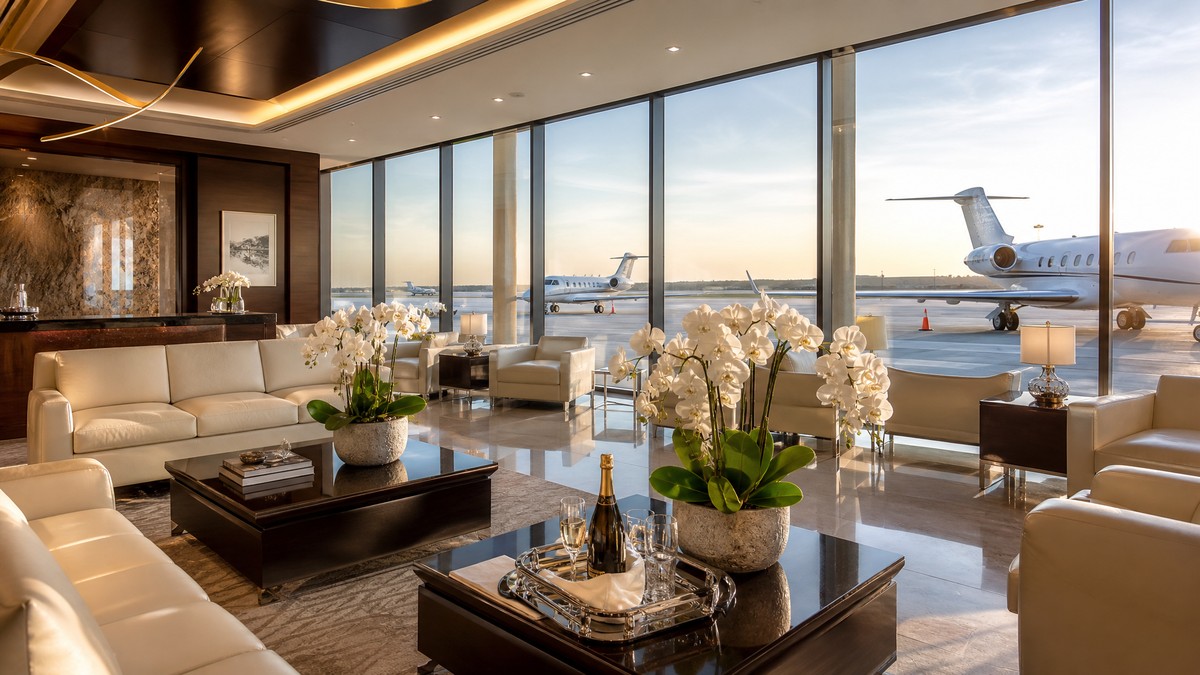
How far in advance should you arrive before take-off?
This is where private flying changes everything: 15 to 20 minutes is sufficient. Regular passengers often arrive 10 minutes before. The crew and aircraft are ready before you are — it is you who sets the pace, not the other way round.
No check-in queue, no luggage drop, no dash to the gate. You put down your jacket, have an espresso, and you are told the aircraft is ready.
Step 3 — Formalities: swift, discreet, queue-free
Document checks
Customs and passport control exist in private flying, but they unfold in a radically different way. For an intra-Schengen flight (e.g. Paris–Nice, Paris–Geneva), no checks are required. For a flight outside Schengen (e.g. Paris–London, Paris–Dubai), the border police check passports — but directly in the FBO lounge, without any queue.
Security
Private jet passengers are subject to security checks, but these are proportionate and discreet. In Europe, certified operators (compliant with EASA regulations) carry out checks on luggage and passengers — often through visual inspection and a discreet scanner, without plastic trays, shoe removal or crowded walk-through arches as seen in commercial aviation. The whole process typically takes fewer than 5 minutes.
Luggage
Your bags are loaded into the hold by the handling team while you are in the lounge. No conveyor belt, no waiting. On arrival, they are placed right next to the aircraft, retrieved in seconds as you step off.
Regarding the rules: the 100 ml liquid restriction does not apply (the rules applied are the operator’s own, generally more flexible than commercial aviation), and cabin baggage is not subject to any standard size gauge.
Step 4 — Boarding: at your own pace
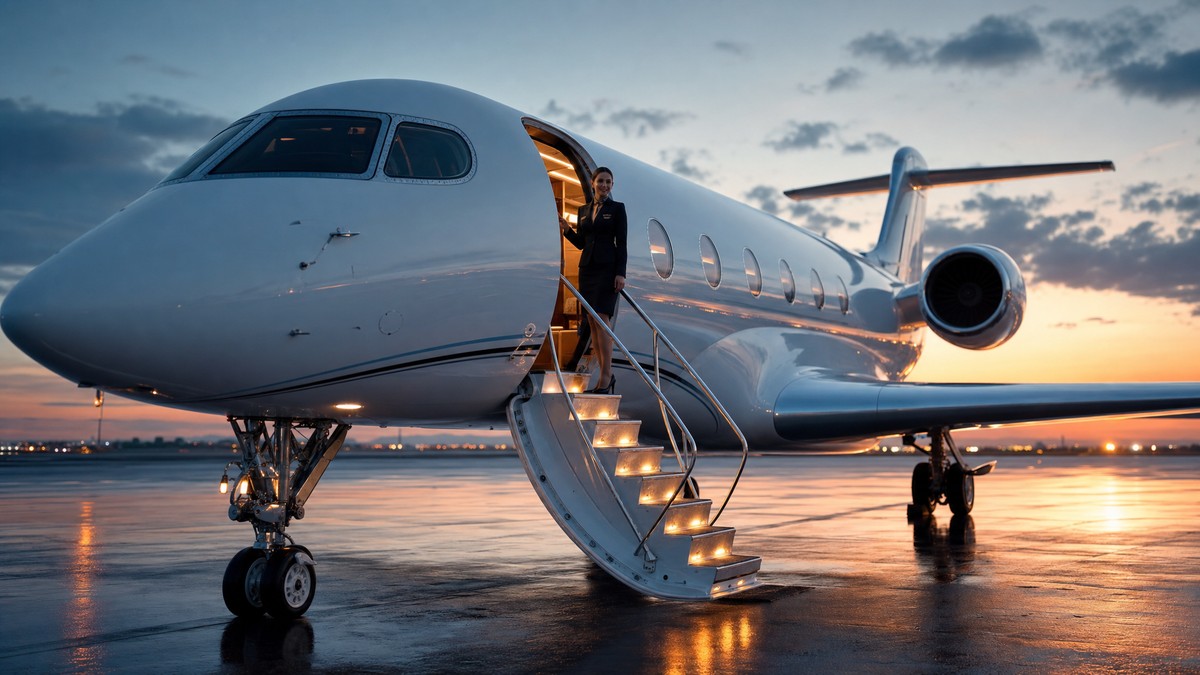
When you are ready, a handling agent guides you on foot — or by car if the distance warrants it — to the aircraft, parked a few dozen metres away. No crowded shuttle, no endless corridor. The aircraft is waiting for you, engines on standby or already running depending on the flight duration.
At the foot of the steps, the captain greets you personally. This is standard practice in high-end private aviation: the captain introduces themselves, informs you of the flight conditions, estimated duration and answers any questions. The flight attendant or steward (present on midsize jets and larger aircraft) takes your jacket and offers you your first drink.
The safety briefing
It is brief and personalised. The crew indicates the emergency exits, the life jacket (for overwater flights) and essential safety instructions — addressing you directly, not 180 passengers at once. On short flights with regular passengers, this briefing can be delivered verbally in 60 seconds.
Step 5 — Departure: a different definition of punctuality
The departure time is the one you have chosen. In the absence of weather delays or air traffic control restrictions, take-off occurs at the scheduled time — or earlier, if all passengers are on board and the crew is ready.
Engine start, departure procedures and runway roll are technically identical to a commercial flight. What differs: no captain’s voice over the intercom (the crew speaks to you directly if needed), freedom to leave your phone on until the captain decides otherwise, and the ability to change destination or make a stop on a simple request, even once airborne.
Can you really change the itinerary in flight?
Yes. This is one of the absolute privileges of private flight. If your meeting in Milan is cancelled during the journey, the captain can amend the flight plan for Zurich or Rome, subject to obtaining the necessary clearances (which can be processed in a few minutes from air traffic control centres). This flexibility is impossible in commercial aviation.
Step 6 — In flight: the on-board experience
The first few minutes
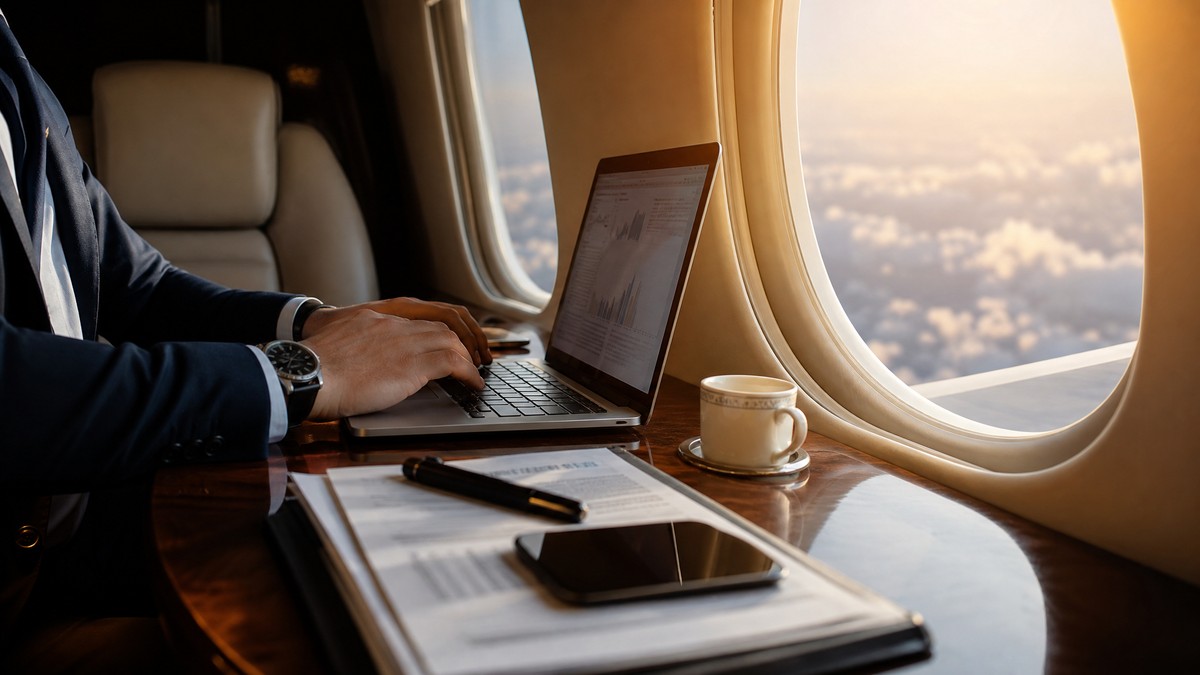
As soon as the fasten-seatbelt sign permits, the cabin is free. You can stand up, change seats, open your laptop, make calls (Wi-Fi available on midsize jets and above). The flight attendant serves drinks and sets out the meal tray if ordered.
In-flight dining
Catering is prepared before the flight by a specialist aviation caterer, based on your preferences communicated at booking. On a light jet for a Paris–London flight, this will typically be a premium cold platter: smoked salmon, selected cheeses, pastries, seasonal fruit, champagne or still water. On a midsize or heavy jet for a multi-hour flight, a proper hot meal is possible — prepared in the galley on board — with starter, main course, dessert and a wine selection.
No trolley blocking the aisle. No reheated plastic-tray meal. Each dish is served on quality tableware, at your own pace.
Cabin noise: the most common surprise
Virtually all first-time private jet passengers mention the same surprise: the silence. Modern business jets register between 52 and 58 dB (explore the interior of a private jet in detail) of cabin noise in cruise — compared with 75 to 85 dB in an Airbus A320. Holding a normal conversation without raising your voice, working without earplugs, sleeping without a mask: this is the level of sound insulation that regular private flyers quickly become accustomed to, and can no longer tolerate losing.
Telephony and connectivity
On midsize jets and larger aircraft, high-speed Wi-Fi (100 Mbps on Starlink systems) enables video calls, online working and streaming. Phone calls are possible. Some aircraft owners have dedicated on-board fixed lines with their own number.
Sleeping in flight
From midsize jets upwards, seats convert into flat beds. On heavy jets and ultra-long-range aircraft, bedroom suites with hotel-quality bedding allow you to sleep in conditions comparable to a five-star hotel. For a Paris–Dubai or Paris–New York flight, this option radically transforms the arrival experience.
Step 7 — Landing and arrival: the symmetry of departure
Landing in a private jet offers a rarely mentioned advantage: access to secondary airports. When a commercial flight lands at Rome Fiumicino (35 km from the centre), your private jet can touch down at Rome Ciampino (15 km) or even Urbe (10 km). In Nice, instead of the main airport, you could consider Cannes-Mandelieu for lighter aircraft. These secondary airports are less congested, faster and often closer to your final destination.
Leaving the aircraft
On landing, the aircraft parks directly in front of the destination FBO. You descend the steps, your bags are already at the foot of the aircraft or in the hall, collected by a handling agent. If you have arranged a transfer, the driver is waiting a few metres away.
From the door opening to settling into the car: 3 to 8 minutes, depending on the airport.
Customs on international arrival
For international flights outside Schengen, customs are handled directly on the tarmac or in the FBO lounge. At many destinations (Dubai, United States, Morocco), customs agents come to the aircraft or FBO for checks, avoiding queues at the main terminal counters. At certain destinations, private jet passengers have a dedicated desk.
Private jet flying in practice: comparison with commercial aviation
| Stage | Commercial flight | Private jet |
|---|---|---|
| Recommended airport arrival | 2h–3h before | 10–20 min before |
| Luggage check-in | 15–30 min in queue | Immediate collection on arrival |
| Security check | 15–45 min in queue | 2–5 min, no queue |
| Gate waiting | 30–60 min | 0 min (aircraft waits for the passenger) |
| Boarding | 20–40 min, by group | 2–3 min, personalised welcome |
| Departure delay | Frequent (25–35% of flights) | Rare, usually weather or ATC |
| In-flight itinerary change | Impossible | Possible, on simple request |
| Luggage collection on arrival | 20–45 min, baggage belt | 2–3 min, at the foot of the aircraft |
| Exit from airport | 15–30 min depending on terminal | 3–5 min, direct access to car |
| Total airport-to-airport time (e.g. Paris–Nice) | ~4h30 (including transit) | ~1h45 (door to door) |
What passengers discover with surprise
The aircraft waits for you, not the other way round
The paradigm is reversed. In commercial aviation, you chase the aircraft. In private aviation, the aircraft waits for your instructions. If you are ten minutes late, the crew waits. If you want to take off 20 minutes early, they adapt.
Freedom of airports
Private jets have access to roughly ten times more airports than commercial airlines. In France, this means you can depart from Cannes-Mandelieu, Deauville, Chambéry, Courchevel or Biarritz without transiting through Paris. This capillarity fundamentally changes the door-to-door journey time calculation.
The cabin crew knows you
For flights arranged by a serious operator, the crew receives a briefing on the passengers in advance: dietary preferences, allergies, habits, spoken language, first and last name. From the moment you board, you are called by your first name, they know your preferred drink and that you take your coffee without sugar.
Silence as a first instinct
At 10,000 metres altitude in a midsize jet in cruise, the silence is so unfamiliar that many passengers instinctively reach for their earplugs — before realising they do not need them. It is this acoustic-bubble sensation that regular private flyers describe as the hardest thing to accept losing on a commercial flight.
FAQ — Your questions about how a private jet flight works
Do you need a passport to fly by private jet?
For intra-Schengen flights (e.g. Paris–Nice, Paris–Geneva, Paris–Rome), a national identity card suffices. For flights outside Schengen (Paris–London, Paris–Dubai, Paris–New York), a valid passport is required, as for any international journey. The rules are identical to commercial aviation on this point.
Can you take liquids in the cabin on a private jet?
The 100 ml liquid restriction applies in principle to private jets as well, but enforcement varies between operators and countries. For intra-European flights, many operators are more flexible. The basic rule: communicate in advance with your operator for any specific question about luggage.
Can you travel with a pet on a private jet?
Yes, and this is one of the great advantages of private flying: pets travel in the cabin, not in the hold. Veterinary documents (European passport, vaccinations, health certificate) must be up to date and communicated to the operator before the flight. For destinations outside the EU, specific rules apply.
What happens if the aircraft has a technical problem before departure?
Serious operators have substitute fleets or agreements with other operators to replace an aircraft in the event of a technical failure. This is a contractual obligation. The probability of finding yourself without an aircraft is very low with a certified operator.
Can you smoke on board a private jet?
Most aircraft are non-smoking in order to preserve the interiors. Some jets can be configured to permit smoking (with specific filtration systems), but this is increasingly rare. Check with the operator at the time of booking.
Is there a maximum baggage weight on a private jet?
Formally, the hold has a limited capacity (which varies by aircraft). In practice, operators communicate the specific constraints of the aircraft at the time of booking. Bulky items (bicycles, skis, surfboards, musical instruments) are generally acceptable if notified in advance.
What is the difference between a private jet flight and a charter flight?
A charter flight is an on-demand flight on an entire aircraft, identical in principle to a private jet. The nuance: the term “charter” is sometimes used for larger aircraft (chartered airliners), whereas “private jet” typically refers to business aircraft of fewer than 20 passengers. The on-board experience differs in direct proportion to the size of the aircraft.