Low-cost private jet: 7 ways to fly for less
“Private jet” and “low cost” sound contradictory. Yet, in 2026, a group of four friends can fly from Paris to Nice for the price of a return business-class ticket — around €1,000 per person. A Paris-Ibiza empty leg can be picked up for €2,500. And a Paris-Geneva business hop on a turboprop rarely tops €2,000 in total. This isn’t fantasy: it’s planning.
This guide rounds up every method for cutting the cost of a private jet flight, the most accessible aircraft, and the real price ranges that few articles dare to spell out clearly.
The 7 ways to fly by private jet for less
1. Empty legs — up to 80% off
This is the most powerful lever. When an operator drops passengers off at a destination and the aircraft has to fly back empty to its base, it offers this repositioning leg at a heavily discounted rate — typically 30 to 80% cheaper than a regular charter on the same route. In practice: a Paris-Nice that costs €6,000 on a normal charter can be booked as an empty leg for €1,500 to €2,500.
The constraints: the route and timing are set by the operator. These offers come up a few hours to a few days in advance. They demand real flexibility on dates and destinations. Where to find them: directly with operators (AeroAffaires, LunaJets, PrivateFly/FXAIR) or on dedicated aggregators such as JetHunter or PrivateFly Empty Legs.
Real-world saving: a transatlantic empty leg (Paris-New York) can drop to €25,000-€35,000, against €60,000-€90,000 on a standard charter.
2. Very Light Jets (VLJ) — from €1,500/h
The VLJ — Very Light Jet — category groups 4 to 6-seat aircraft whose operating cost is significantly lower than standard jets. On a Paris-Nice (1h10 flight), a VLJ can come out at €3,500-€5,500 in total, i.e. €870 to €1,375 per passenger for a group of 4. The most common models:
- Cessna Citation Mustang: 4 seats, 1,167 nm range, ~€1,500-€2,000/h. The most accessible entry point on the jet market.
- Embraer Phenom 100E: 4-5 seats, 1,178 nm, ~€1,800-€2,500/h. More modern cabin, better connectivity.
- Cirrus Vision Jet: 5 seats (including 2 children), single-engine, ~€1,500-€2,200/h. The most affordable private aircraft to buy (~US$2 m new).
- Eclipse 550: 4 seats, twin-engine, ~€1,500-€2,000/h. Fuel-efficient, ideal for short European hops.
Limit: these aircraft are not suited to flights over 2 hours — cabin volume is restricted and performance in turbulent air is lower than on heavier jets.
3. Turboprops — the most economical option on short distances
For trips under 500 km (Paris-Brussels, Paris-Lyon, Paris-Geneva), a turboprop is often the most rational choice. Slower than a jet (cruise speed ~550 km/h vs 800 km/h), but markedly cheaper per flight hour. The benchmarks:
- Pilatus PC-12 NG: 6-9 seats, excellent access to small airfields, ~€900-€1,400/h. The Swiss Army knife of accessible private aviation.
- Beechcraft King Air 350: 8-9 seats, 1,806 nm, ~€1,200-€1,800/h. Widespread in Europe, many operators.
- TBM 960: 5 seats, single-engine turboprop, ~€800-€1,200/h. Fast (630 km/h) for the category, well-suited to solo/duo business flights.
On a Paris-Geneva (45 min), a PC-12 with 4 passengers comes out at around €1,500-€2,500 in total — i.e. less than €625 per person.
4. Co-flying and shared flights
Co-flying involves sharing an existing private flight with other unrelated passengers. There are two forms:
- Seats on shared private jets: platforms such as XO (formerly JetSmarter) offer “shared flights” on recurring routes (Paris-Nice, Paris-Ibiza…). Price: €300 to €800 per seat depending on the route. Constraint: fixed timetable, calendar compatibility.
- Cost-sharing on light aircraft (Wingly): this model, legally distinct from charter, lets private pilots share the actual flight costs with passengers. Price: €50 to €250 per seat on regional trips. It isn’t a private jet — but it is private aviation accessible to everyone.
Co-flying cuts the per-head cost by 50 to 70% — but means sharing the cabin with strangers and aligning timings.
5. Subscriptions and jet cards — the guaranteed hourly rate
Jet card programmes let you buy flight hours at a guaranteed rate, with no variable fuel surcharges. Ideal if you log 20 to 50 flight hours a year. The advantages:
- Hourly rate known in advance, no surprises
- Fast availability (4 to 10 hours depending on operator)
- No ferry fees on most programmes
Operators such as Wijet (France) offer a monthly subscription with an hourly rate of around €2,400/h on light jets — twice as cheap as the spot rate of competitors. XO and Air Partner offer jet cards from €25,000 of initial deposit.
6. Round trips and airport flexibility
A one-way flight often forces a “ferry flight”: the aircraft has to be repositioned, and that cost is passed on to you. A same-day return eliminates this ferry and sometimes cuts the total cost by a factor of 1.5 to 2. Example: a Paris-Nice one-way can cost €6,500 (ferry included), against €8,000 round trip — i.e. €4,000 per leg.
On airports: departing from a secondary airport (Pontoise, Lognes, Toussus-le-Noble rather than Le Bourget) can save €500 to €1,500 in slots and handling fees. On the destination side, Nice-Cannes Mandelieu is often cheaper than Nice-Côte d’Azur for light jets.
7. Off-season and weekdays
Private jet demand follows school holidays and seasons. Outside Christmas, summer and weekends, operators are more open to negotiation: high availability, less competition between clients. A Tuesday or Wednesday flight can be 15 to 25% cheaper than a Friday evening on leisure routes (Paris-Ibiza, Paris-Mykonos). November, January and February are usually the cheapest months of the year.
Table of the most accessible aircraft to charter in 2026
| Category | Model | Seats | Range | Hourly rate | Ideal use |
|---|---|---|---|---|---|
| Turboprop | TBM 960 | 4-5 | 1,730 nm | €800-€1,200/h | Solo/duo, trips <500 km |
| Turboprop | Pilatus PC-12 NG | 6-9 | 1,845 nm | €900-€1,400/h | Small groups, small airfields |
| Turboprop | King Air 350 | 8-9 | 1,806 nm | €1,200-€1,800/h | Groups, short-haul Europe |
| Very Light Jet | Cirrus Vision Jet | 4-5 | 1,275 nm | €1,500-€2,200/h | Duo/trio, 1-2h trips |
| Very Light Jet | Citation Mustang | 4 | 1,167 nm | €1,500-€2,000/h | Entry-level jet, Europe |
| Very Light Jet | Phenom 100E | 4-5 | 1,178 nm | €1,800-€2,500/h | Short business hops, comfort+ |
| Light Jet | Phenom 300E | 6-7 | 2,010 nm | €2,500-€3,500/h | All of Europe, groups of 6 pax |
| Light Jet | Citation CJ4 | 7-8 | 2,165 nm | €2,800-€3,800/h | France-Med, business groups |
Real prices: what an “accessible” flight from Paris actually costs
Here are real rates seen on the 2026 market, on-demand charter on the most affordable aircraft:
| Route | Aircraft | Total price | Price/person (4 pax) | Duration |
|---|---|---|---|---|
| Paris → Nice | Citation Mustang | €3,500-€5,500 | €875-€1,375 | 1h10 |
| Paris → Geneva | Pilatus PC-12 | €2,000-€3,500 | €500-€875 | 55 min |
| Paris → London | Phenom 100E | €4,000-€6,000 | €1,000-€1,500 | 1h |
| Paris → Ibiza | Citation CJ3 | €7,000-€11,000 | €1,750-€2,750 | 2h15 |
| Paris → Barcelona | King Air 350 | €5,000-€8,000 | €1,250-€2,000 | 1h45 |
| Paris → Mykonos | Phenom 300E | €12,000-€18,000 | €3,000-€4,500 | 3h15 |
| Paris → Marrakech | Citation CJ4 | €9,000-€14,000 | €2,250-€3,500 | 2h45 |
Indicative 2026 prices on on-demand charter. An empty leg on the same routes can be 40 to 70% cheaper.
What “low cost” does not mean in private aviation
It’s important to clarify what the search for savings should not entail in private aviation.
Safety is non-negotiable
An abnormally low rate may indicate an operator without third-party certification (ARGUS, Wyvern), an ageing and poorly maintained aircraft, or an inexperienced crew. Before any booking, check that the actual operator (not just the broker) holds a valid AOC and an independent safety certification. ARGUS Platinum or Wyvern Wingman are the industry standards.
Very Light Jets have real limits
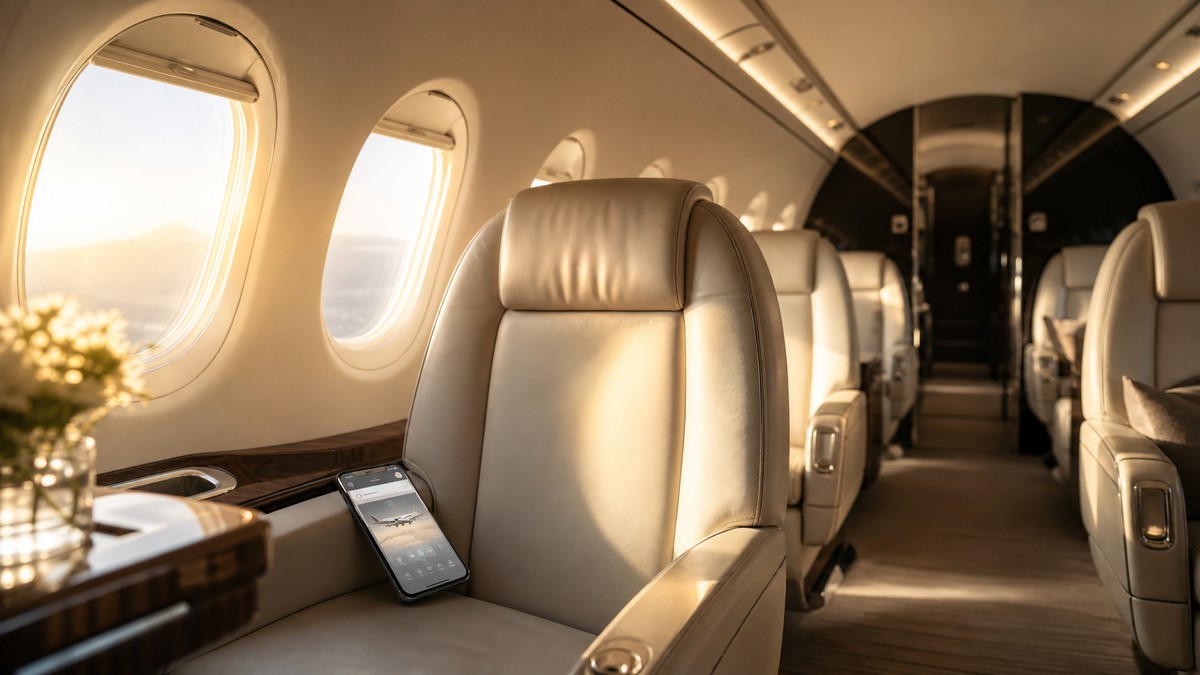
A VLJ is not a heavy jet in miniature. The cabin height (often 1.25 to 1.45 m) forces a stooped posture. Everything about private jet cabins. Baggage is limited. In strong winds or icing conditions, performance degrades faster than on a higher-category aircraft. For a 1-hour trip with 4 people, it is perfectly suited. For a 2h30 Paris-Madrid with luggage, it’s borderline.
The “price per hour” doesn’t tell the whole story
An hourly rate of €1,500/h on a VLJ that flies 1h10 is cheaper than €3,000/h on a light jet — but the first one’s ferry flight may inflate the bill if the aircraft is coming from far away. Always compare on the final “all-in” price for the precise route you’re flying.
FAQ — Low-cost private jet
What is the minimum price to charter a private jet?
In 2026, the cheapest private jet flight starts at around €1,500 to €2,000 for a very short trip (under 45 min) on a turboprop on a route with no ferry flight. A Paris-Geneva on a Pilatus PC-12 can be negotiated around €2,000-€2,500. As an empty leg on a VLJ, offers under €2,000 occasionally come up on intra-French routes.
Is it really cheaper to fly by private jet than first class with several people?
On certain routes, yes. Paris-Nice in Air France first class costs €300-€500 per person one-way. A VLJ at €3,500 total for 4 people works out at €875 per person — more expensive. But factoring in the time saved (private terminal, immediate boarding, no need to arrive 1h30 in advance), the tipping point sits around 3-4 people on destinations where commercial flights are infrequent or poorly timed.
Are empty legs reliable?
Yes, provided you understand their nature. An empty leg can be cancelled if the “outbound” flight that precedes it is itself cancelled (client cancellation, technical issue). This risk is real but limited on offers from certified operators. Read the cancellation conditions carefully before booking, especially if you have commitments at arrival.
Is co-flying legal?
Co-flying via platforms such as Wingly is legal in Europe under specific regulations: the pilot must own or rent the aircraft, fly on their own account, and only share the actual costs (fuel, fees, rental) without making a profit. It is not commercial aviation — passengers share the flight risk with the pilot.
How do I find empty legs from France?
The best sources in 2026: brokers’ platforms (AeroAffaires, LunaJets, PrivateFly/FXAIR) which publish their empty legs in real time, email alerts from operators (NetJets, VistaJet for programme members), and aggregators such as JetHunter or privatejet.com. The most common routes from France: Paris-Nice, Paris-Biarritz, Paris-Bordeaux, and seasonal destinations (Ibiza, Mykonos, Courchevel).
Is a jet card subscription really worth it?
For a profile flying between 20 and 50 hours a year on regular European routes, a jet card with an operator like Wijet or Air Partner is economically superior to spot charter: guaranteed hourly rate, no hidden fees, fast availability. Below 15 hours/year, on-demand charter remains more flexible and often cheaper overall.